We may earn a commission when you buy through links on this page, at no extra cost to you. How this works.
Pickleball demands quick pivots, sudden stops, and constant weight shifts - movements that rely heavily on core stability and lower-body control. For players over 60, maintaining that balance becomes both more important and more challenging as natural changes in muscle tone, joint flexibility, and proprioception occur with age.
Balance boards offer a practical way to address these changes without the impact stress of jumping drills or the joint load of heavy lifting. By training on an unstable surface, you engage the small stabilizer muscles in your ankles, hips, and core that keep you upright during those split-second reactions at the kitchen line. This type of training translates directly to better footwork, fewer stumbles during lateral reaches, and greater confidence when changing direction quickly.
The challenge for senior athletes is finding balance boards that build strength without introducing unnecessary fall risk. Many boards designed for younger users are too aggressive - high wobble angles, minimal handholds, and narrow platforms that can turn a training session into a hazard. What works better are boards with controlled tilt ranges, non-slip surfaces, and enough platform width to accommodate a comfortable stance.
Home training with the right balance board means you can work on stability during off-court days, in short sessions that fit around your schedule, and with intensity you control. The goal is functional strength: the ability to plant, pivot, and recover without hesitation when a fast exchange comes your way. Choosing a board that matches your current balance level and allows gradual progression makes that goal achievable without compromising safety.
Quick comparison
| 3-in-1 Slant Board & Balance Board, Adjustable Calf Stretcher for Physical Therapy | Check current price and availability |
| Wooden Anti-Slip Wobble Balance Board for Physical Therapy, Core Strength & Standing Desk | Check current price and availability |
| Frgofl Adjustable Single Leg Balance Board for Ankle Strengthening & Physical Therapy | Check current price and availability |
Fit and safety come first
Use the comparison as a shortlist, but keep fit, comfort, and any health or safety constraints ahead of price.
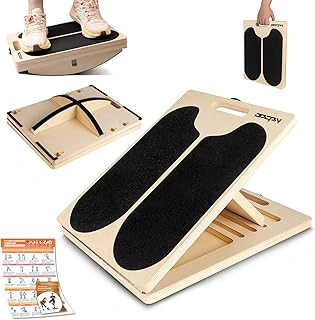
3-in-1 Slant Board & Balance Board, Adjustable Calf Stretcher for Physical Therapy
Seniors who want a balance board they can adjust as their strength improves will find the 3-in-1 Slant Board & Balance Board a practical choice. This board offers three fixed angle positions, allowing you to begin with a gentle tilt and increase the challenge over weeks or months as your core stability develops. The adjustable design reduces the risk of starting with too steep an incline, which can lead to wobbles or falls during early training sessions.
Beyond balance work, the board doubles as a calf stretcher, making it useful for post-pickleball stretching routines. Tight calves are common after court time, and the ability to use the same piece of equipment for both balance drills and lower-leg flexibility means you get two training tools in one compact package. The dual function saves floor space and justifies the $27.54 price point, which is higher than single-purpose foam boards but lower than electronic or rocker-style balance trainers.
The 4.5 rating reflects solid construction and straightforward usability. The fixed positions lock securely, so you won't experience unexpected shifts mid-exercise. The tradeoff is size and portability: adjustable slant boards tend to be bulkier than simple wobble boards, and you'll need a stable surface and a bit of clear floor area to use it comfortably. If you want a board that grows with your ability and doubles as a stretching tool,check current price and stock.
This board suits seniors who prefer a structured progression and value versatility over minimal footprint. The ability to start conservatively and add challenge without buying a second product makes it a safer long-term investment for core and lower-body training.
- ✅ Three adjustable angle positions for progressive training
- ✅ Doubles as calf stretcher for post-game flexibility work
- ✅ Fixed positions lock securely to prevent mid-exercise shifts
- ✅ Priced lower than electronic or rocker-style balance trainers
- ⚠️ Bulkier than simple wobble boards, requires more storage space
- ⚠️ Higher cost than single-function foam balance boards
What to Look for in a Balance Board for Safe Senior Training
Choosing a balance board that matches your current ability matters more than selecting the most challenging model. Seniors building stability for pickleball should prioritize platform width, surface grip, and tilt range before considering advanced features.
Start with surface width and texture. A platform between 15 and 18 inches across gives you room to adjust your stance without stepping off the edge. Look for textured rubber, cork, or foam top layers that grip through socks or athletic shoes. Smooth wood or plastic surfaces become slippery when feet shift, especially during longer sessions.
Base stability determines how much the board tilts and in which directions. Rocker boards pivot along one axis and offer the gentlest introduction, limiting side-to-side motion to a controlled arc. Wobble boards tilt in all directions but come in different height profiles: lower domes allow 10 to 15 degrees of tilt, while taller bases push past 20 degrees. Beginners should start with rocker or low-wobble designs; higher angles demand faster reflexes and stronger ankle stability.
Adjustability extends the useful life of your board. Some models include removable stoppers that restrict tilt range or interchangeable bases that increase difficulty as balance improves. This progressive approach reduces the need to buy a second board six months later.
Check the stated weight capacity against your body weight, adding a 50-pound buffer for dynamic movement. Most senior-focused boards support 250 to 300 pounds, but confirm the number in the product specs rather than assuming all boards handle the same load.
Chair-assisted compatibility is often overlooked. Boards with non-slip rubber bottoms stay put on tile, hardwood, or carpet when you rest one hand on a chair back during early practice. Metal or hard plastic bases can slide unexpectedly, turning a controlled drill into a balance emergency.
The core tradeoff is simple: broader bases and gentler tilt angles feel safer and build confidence, but they deliver smaller strength gains per session. Narrower platforms and steeper angles accelerate core and ankle adaptation but increase fall risk if introduced too soon. For pickleball players returning to balance training after time off, the safer option always outperforms the aggressive one.
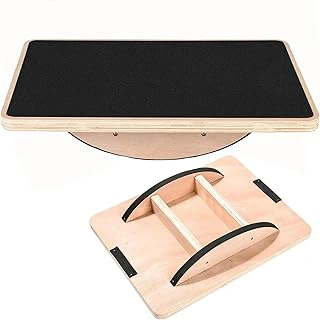
Wooden Anti-Slip Wobble Balance Board for Physical Therapy, Core Strength & Standing Desk
Seniors who want balance training woven into everyday life - not just dedicated workout time - will find this round wooden wobble board practical and affordable. At $22.99 with a 4.6 rating, it delivers multiple-degree tilt in a simple design that works on carpet or hardwood, making it easy to use while answering email at a standing desk or during commercial breaks in the living room.
The anti-slip textured surface grips socks or bare feet without requiring straps or footwear, and the continuous wobble motion engages lateral stabilizers that translate directly to the side-to-side weight shifts you need on the pickleball court. Unlike fixed-angle rockers, this board moves in every direction, so your ankles and core adjust constantly to find center - building the reflexive stability that helps you recover position after a reach or pivot.
The tradeoff for simplicity is the lack of adjustability. The wobble range is fixed, and beginners should keep a chair or countertop within arm's reach for the first few sessions. Start with multiple-second intervals rather than extended standing; your feet and calves will adapt faster if you build duration gradually. Once you're comfortable, the board becomes an easy add-on to daily routines: use it while folding laundry, waiting for coffee, or during any standing task that doesn't require quick movement.
The everyday usability multiplies the value. You're not storing a dedicated piece of therapy equipment that only comes out twice a week - you're adding low-level balance challenge to activities you already do, which means more cumulative practice without carving out extra time. For a board that fits into your daily routine at a lower price,check current availability.
- ✅ Affordable at $22.99 with strong 4.6 rating
- ✅ Anti-slip surface works with bare feet or socks
- ✅ 360-degree tilt builds lateral stability for pickleball movement
- ✅ Easy to integrate into standing desk or daily home routines
- ⚠️ No adjustability - wobble range is fixed
- ⚠️ Beginners need chair support and short sessions at first
- ⚠️ Continuous motion may fatigue feet and calves initially
How to Use a Balance Board Safely at Home
- Place the board on a non-slip mat or carpet to prevent sliding during use
- Position a sturdy chair or countertop within arm's reach for the first four weeks
- Wear supportive athletic shoes with good tread, not socks or slippers
- Start with two-minute sessions, three times per week, and add one minute every two weeks
- Keep your knees slightly bent and core engaged; avoid locking your legs
- Practice weight shifts side to side before attempting full wobbles or tilts
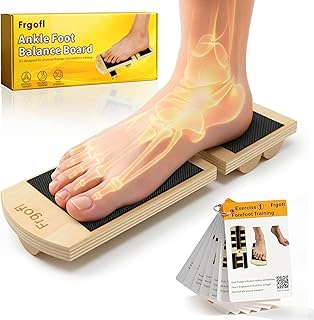
Frgofl Adjustable Single Leg Balance Board for Ankle Strengthening & Physical Therapy
At $8.99, the Frgofl single-leg balance board offers the lowest entry cost for seniors who want to work on ankle stability and single-leg strength. It holds a 4.5 rating and includes an adjustability feature that lets you control the degree of tilt, making it possible to start with gentler movement and increase the challenge over time.
The single-leg design demands more from your balance system than full-stance boards. You stand on one foot while the platform rocks beneath you, which recruits stabilizer muscles around the ankle and engages your core as you work to stay centered. This format can improve proprioception and prepare you for the quick weight shifts pickleball requires, but it also increases fall risk compared to boards where both feet stay grounded.
If you already maintain reasonable balance during daily activities or can position a sturdy chair within arm's reach, this board becomes a practical tool for targeted ankle work. Use it for short intervals at first, keeping one hand on the chair back until your confidence builds. The compact size makes it easy to store in a closet or slide under a bed, and the price point removes the barrier if you're uncertain whether balance training will fit your routine.
The tradeoff is clear: single-leg boards require more initial stability than double-stance options, so they suit seniors who have passed beginner balance work or those willing to practice with support nearby.Check current price and availabilityif you want the lowest-cost option for ankle-focused work and have a safe setup for practice.
This board works best as a supplement for active seniors who already use a full-stance balance board and want to add ankle-specific drills, or as a low-risk test purchase for those exploring balance training without committing to a larger investment.
- ✅ Lowest price at $8.99
- ✅ Adjustable tilt for gradual progression
- ✅ Compact size for easy storage
- ✅ Targets ankle stability and single-leg strength
- ⚠️ Single-leg design increases fall risk for beginners
- ⚠️ Requires existing balance or chair support
- ⚠️ Not suitable as a first balance board for most seniors
Comparing the Three Boards: Which One Fits Your Training Level?
Choosing the right balance board depends on where you are today, not where you hope to be in six months. Start by asking how comfortable you feel standing on one leg for twenty seconds. If that's already challenging, the three-level adjustable board gives you the safest entry point and lets you increase difficulty as your core strength improves. The removable springs and dual stretching function mean you're buying one tool that adapts rather than replacing equipment as you progress.
The wooden wobble board works best if you can already handle basic single-leg balance and want something that blends into your living space. Its continuous tilting motion trains lateral stability - the side-to-side control that matters during quick direction changes on the pickleball court. Because it sits near eye level when placed by a chair or couch, it's easier to use throughout the day for short sessions rather than hauling out dedicated training gear.
Budget plays a real role here. The single-leg foam board costs less than half the price of the adjustable option, but it assumes you're ready for a fixed challenge level. If you're recovering from a fall or haven't done balance training before, starting at that difficulty without progression steps can feel discouraging or unsafe. On the other hand, if your doctor has cleared you for moderate balance work and you want a simple tool for maintenance rather than building new strength, the foam board delivers without extra features you won't use.
Consider whether you're more likely to use a board that becomes part of your environment or one that stays in a closet between formal exercise sessions. The wobble board's smaller footprint and living-room-friendly design encourages frequent short practices. The adjustable board requires more space and setup but offers structure for people who prefer scheduled training blocks. Neither approach is better - match the format to how you actually build habits, not how you wish you did.
Building Core Strength That Translates to the Pickleball Court
Balance board training strengthens the exact muscles you rely on during quick pickleball exchanges. When you shift your weight on an unstable surface at home, you're rehearsing the same core engagement needed for lateral shuffles at the net, sudden pivots to track a baseline lob, or holding a stable low position through a long dinking rally.
A stronger core reduces how much compensatory work your knees and shoulders have to perform. If you've felt soreness in those joints after a match, improved trunk stability can take meaningful pressure off both areas by keeping your movement centered and efficient.
Consistent practice - three to four short sessions each week - usually produces noticeable improvements in on-court balance within six to eight weeks. You'll likely find yourself recovering position faster after a wide shot and maintaining steadier footing when you're forced to reach or twist quickly.
The connection isn't automatic; balance board work doesn't replicate the exact demands of live play. Think of it as foundational conditioning that makes every other movement more controlled and less risky, rather than a direct substitute for court time.
Your Next Step: Start Slow and Track Your Progress
Choosing the right balance board starts with an honest look at where you are now. If you're returning to fitness after time off or manage occasional joint discomfort, the adjustable 3-in-1 board offers the safest progression. Already steady on your feet? The everyday wobble board gives you reliable core work without setup steps. Working within a tighter budget or focusing on single-leg drills? The single-leg trainer delivers targeted stability practice.
Commit to three short sessions each week - ten to fifteen minutes is enough. Grab a notebook and jot down the date, how long you stayed on the board, and how stable you felt. That simple log turns scattered effort into visible progress and helps you spot patterns: maybe you're steadier in the morning, or your left leg needs more attention than your right.
Consistency matters more than duration. Two weeks of three brief sessions will do more for your balance than one ambitious hour that leaves you sore and discouraged. Stability training is cumulative; each session builds neural pathways that keep you upright during quick pivots and sudden stops on the court.
These boards are tools, not magic fixes. Pair your balance work with the movement habits you already know - walk regularly, stretch tight hips, and stay active in ways you enjoy. Over time, that combination supports years of confident play and reduces the chance of a stumble turning into something worse.
Review the adjustable 3-in-1 board, the everyday wobble board, or the budget single-leg trainer to find your fit, then mark your calendar for this week's first session.