We may earn a commission when you buy through links on this page, at no extra cost to you. How this works.
Cold muscles and stiff joints don't tolerate sudden lateral movements, overhead reaches, or quick pivots without consequence. For players over 60, the rotator cuff, knee ligaments, and hip flexors need gradual activation before you step onto the court. Resistance bands provide controlled tension that increases blood flow and range of motion without the impact of jumping jacks or the complexity of dynamic stretches that require balance.
Most pickleball injuries among seniors occur in the first two games, when enthusiasm outpaces physical readiness. A five-to-eight-minute resistance band routine targets the specific muscle groups you'll recruit during serves, dinks, and backpedaling. The bands allow you to adjust tension precisely, which matters when one shoulder is tighter than the other or your knees need extra care on cold mornings.
Quick comparison
| AugKnot Resistance Bands 5-Levels Exercise Set for Pull Up Assistance | Check current price and options |
| LEEKEY Resistance Bands Set with Handles, Pull Up Assist, and Door Anchor | View full set details and pricing |
| Black Pull Up Assistance Exercise Bands | See availability and specifications |
Fit and safety come first
Use the comparison as a shortlist, but keep fit, comfort, and any health or safety constraints ahead of price.
How Resistance Bands Safely Prepare Your Muscles for Play
Resistance bands work by providing progressive tension throughout the entire range of motion. Unlike static stretching, which can temporarily reduce power output, band exercises activate muscle fibers and connective tissue simultaneously. This primes the neuromuscular pathways you'll use when tracking a fast ball or changing direction at the net.
The elastic resistance also accommodates your current mobility. If your shoulder rotation is limited on Tuesday morning, the band provides exactly the resistance you can handle that day. As you warm up, you can increase the stretch incrementally. This self-regulating quality makes bands particularly valuable for players managing arthritis, previous rotator cuff issues, or knee sensitivity. The key is choosing a resistance level that challenges without straining, which we'll address in detail below.
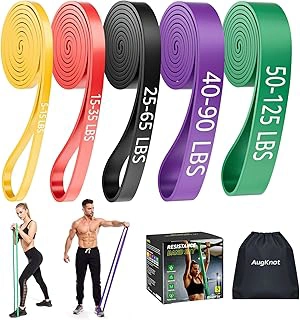
AugKnot Resistance Bands 5-Levels Exercise Set for Pull Up Assistance
This five-band set gives you multiple resistance options in one package, which is practical when you're warming up different muscle groups. The lightest band works well for shoulder external rotation exercises, while the medium bands suit hip abduction and knee stabilization movements. Each band is a continuous loop, so there are no handles to fumble with when you're standing on cold pavement next to the court.
The set includes levels ranging from very light to heavy resistance. Most senior players will use the two or three lightest bands for warm-up work, reserving the heavier options for home strengthening routines. The 4.6 rating reflects consistent quality, though the bands can feel stiff when first removed from the package. Imagine arriving at the court on a chilly morning: you anchor the lightest band under your foot and perform ten controlled shoulder raises before your first serve. That controlled tension prepares the rotator cuff without overloading it.
- ✅ Five resistance levels for different exercises
- ✅ Continuous loop design requires no handles
- ✅ Lightest bands suitable for shoulder warm-ups
- ⚠️ Bands may feel stiff initially
- ⚠️ Heavier bands often unnecessary for warm-up
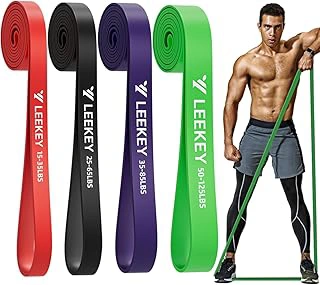
LEEKEY Resistance Bands Set with Handles, Pull Up Assist, and Door Anchor
The handles and door anchor in this set expand your warm-up options beyond basic loop bands. You can attach the bands to a fence post at the court and perform controlled rows or chest pulls, which activate the back muscles that stabilize your paddle arm. The handles provide a secure grip, useful if you have reduced hand strength or arthritis in your fingers.
This set includes multiple resistance levels plus accessories. The door anchor is more relevant for home use, but the handles make courtside exercises easier to perform with good form. The padded grips reduce hand fatigue during repetitions. Picture yourself setting up next to the court fence: you clip the band to the post at shoulder height and pull back slowly, engaging the muscles between your shoulder blades. That activation helps prevent the forward shoulder collapse that leads to rotator cuff strain during extended rallies.
- ✅ Handles provide secure grip for those with hand issues
- ✅ Multiple resistance levels included
- ✅ Accessories enable varied exercise options
- ⚠️ Door anchor less useful at outdoor courts
- ⚠️ More components to carry than simple loop bands
Black Pull Up Assistance Exercise Bands
At $6.99, this single-band option is the most economical choice if you want to test whether resistance band warm-ups work for you. The band is a continuous loop with no accessories, making it simple to toss in your gear bag. It's suited to basic warm-up movements like banded squats, lateral leg raises, and shoulder rotations.
Because this is a single band, you can't adjust resistance by switching to a different level. You'll need to determine whether the tension is appropriate for your current strength and mobility before purchasing. The low price point makes it a reasonable trial option. Consider a scenario where you're unsure whether bands will become part of your routine: you buy this single band, use it for two weeks of pre-game shoulder work, and decide based on results whether to invest in a multi-band set. The 4.6 rating suggests it holds up to regular use despite the budget price.
- ✅ Very affordable entry point
- ✅ Simple continuous loop design
- ✅ Lightweight for transport
- ⚠️ No resistance options included
- ⚠️ Limited to single tension level
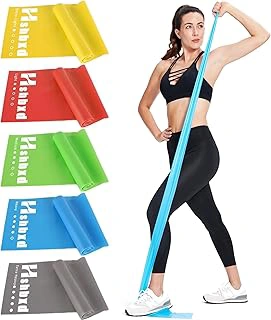
Latex Free Resistance Bands for Exercise and Physical Therapy
If you have a latex allergy or skin sensitivity, this set solves a common problem. Many resistance bands use natural rubber latex, which can cause reactions ranging from mild irritation to serious allergic responses. These latex-free bands are made from synthetic materials that provide similar elasticity without the allergen risk.
The physical therapy designation indicates these bands are designed for controlled, rehabilitative movements rather than high-intensity training. That specification aligns well with senior pickleball warm-up needs. The bands typically come in multiple resistance levels, allowing you to progress gradually. Imagine you've had a previous shoulder injury and your physical therapist recommended continued band work: these latex-free options let you maintain your warm-up routine without skin irritation. The 4.6 rating and the physical therapy focus suggest consistent, gentle resistance suitable for joint preparation.
- ✅ Latex-free for those with allergies
- ✅ Physical therapy design suits gentle warm-up
- ✅ Multiple resistance levels typically included
- ⚠️ Availability status unknown
- ⚠️ May cost more than latex alternatives
How to Choose the Right Resistance Level to Avoid Strain
The correct resistance level allows you to complete 10 to 15 repetitions with good form while feeling muscle activation but not pain. For shoulder warm-ups, start with the lightest band available. Your rotator cuff muscles are small and fatigue quickly; overloading them before play increases injury risk rather than reducing it.
For hip and leg exercises, you can typically handle slightly more resistance. A band that provides moderate tension during lateral leg raises or banded squats will activate the gluteus medius and quadriceps without stressing the knee joint. If you feel sharp pain, hear clicking, or can't maintain proper posture during the movement, the resistance is too high. Many senior players benefit from keeping two bands in their gear bag: a very light one for shoulders and a light-to-medium one for lower body work. Test each band at home first, performing your planned exercises slowly to confirm the tension is appropriate.
Key Pre-Game Exercises for Shoulders, Hips, and Knees
- Banded shoulder external rotation: Stand on band center, hold ends at waist, rotate forearms outward
- Banded shoulder raises: Stand on band, raise arms forward to shoulder height, control descent
- Lateral leg raises: Loop band around ankles, lift one leg sideways against resistance, stabilizes knee
- Banded squats: Place band above knees, squat while pressing knees outward, activates hip stabilizers
- Hip flexor march: Band around thighs, march in place against resistance, warms hip flexors
- Banded calf raises: Stand on band center, hold ends at shoulders, rise onto toes
Frequently Asked Questions About Warming Up for Pickleball
How long should I warm up before playing? Five to eight minutes of resistance band work followed by two to three minutes of easy movement on the court prepares most senior players adequately. If you're playing on a cold morning or have joint stiffness, extend the band routine to ten minutes.
Can I skip the warm-up if I'm only playing one game? Even a single game requires sudden accelerations and overhead reaches. The injury risk doesn't decrease because you're playing fewer games. A brief warm-up is always worthwhile.
Should I stretch after using the bands? Light stretching after band exercises is fine, but avoid aggressive static stretching before play. Save deeper stretching for after your session when muscles are fully warm.
How do I know if the band is too strong? If you can't complete ten repetitions with good form, or if you feel pain rather than muscle tension, the resistance is too high. Switch to a lighter band.