We may earn a commission when you buy through links on this page, at no extra cost to you. How this works.
Senior pickleball players face a specific challenge: the sport demands quick lateral steps, overhead reaches, and sudden directional changes that can feel jarring when joints are cold or muscles are tight. A structured warm up routine bridges the gap between resting circulation and the dynamic movement patterns pickleball requires, helping you feel stable through split-steps, comfortable during deep lunges to low balls, and confident raising your paddle overhead without shoulder stiffness.
This routine is built for players who want to reduce the sensation of joint stiffness in the knees, hips, and shoulders before stepping onto the court. It prioritizes controlled mobility work over static stretching, focusing on movements that mimic pickleball's rotation, side-to-side weight shifts, and multi-plane reaches. Whether you play recreationally twice a week or compete in local tournaments, spending eight to twelve minutes on targeted activation helps your body respond more smoothly when the first serve comes your way.
The warm up is divided into three phases: joint mobility to lubricate hips, knees, and shoulders; dynamic stretches that lengthen muscles while keeping blood flowing; and on-court activation drills that rehearse the exact movement vocabulary pickleball demands. Each phase prepares a different layer - connective tissue, muscle elasticity, and neuromuscular timing - so you feel ready rather than rushed when play begins.
You do not need special equipment, prior flexibility, or a large space. The entire sequence can be performed courtside using the fence, a bench, or the ground for balance support. The goal is not to achieve maximum range of motion or break a sweat, but to match your body's readiness to the specific loads pickleball places on knees during lunges, shoulders during dinks, and ankles during quick pivots.
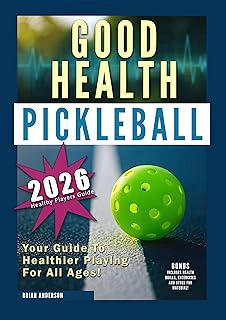
Brian Anderson Good Health Pickleball Guide
Senior players looking for a structured approach to warm up sequences and long-term health on the court may benefit from the Brian Anderson Good Health Pickleball Guide. Rated 4.7 out of 5, this resource is designed for players who prioritize injury prevention, conditioning, and sustainable play over high-intensity competition.
The guide covers warm up routines, mobility work, and play strategies tailored to the needs of older athletes. Rather than focusing solely on power or advanced tactics, it emphasizes movement preparation, joint care, and pacing - making it a practical complement to the warm up framework outlined in this article.
Because it aligns with the goals of players seeking consistency and comfort over time, the guide is best suited for those who want a methodical, health-first approach to pickleball. Players looking for quick tips or competitive drills may find the material more deliberate than they need, but those committed to maintaining mobility and reducing stiffness will appreciate the detail.
If your warm up routine is part of a broader effort to stay active and injury-aware, this guide provides the kind of structured support that complements court time without demanding advanced fitness or experience.
- ✅ Rated 4.7/5 for senior-focused content
- ✅ Emphasizes warm up routines and joint mobility
- ✅ Designed for longevity and injury prevention
- ✅ Complements health-first play strategies
- ⚠️ More deliberate pacing may not suit competitive players
- ⚠️ Focused on conditioning over power tactics
What a Warm Up Actually Does for Senior Players
A warm up increases the temperature of your muscles and lubricates your joints by stimulating synovial fluid production, which reduces the stiffness many senior players feel when stepping onto the court cold. Warmer muscles contract and relax more efficiently, giving you better access to your full range of motion during serves, volleys, and lateral shuffles. The routine also activates the neuromuscular pathways that coordinate balance, timing, and reaction speed - skills that can feel sluggish without a few minutes of intentional movement.
For senior players, the goal is not simply to "loosen up" but to prepare the specific joints and movement patterns pickleball demands. Your shoulders need rotation for serves and overhead smashes, your hips and knees require stability for split-steps and direction changes, and your ankles must handle quick pivots on hard courts. A structured warm up primes these areas in sequence, bringing blood flow to connective tissue and rehearsing the ranges you will use during play.
This preparation helps you move with greater comfort and confidence from the first point, reducing the awkward stiffness that can compromise your footwork and stroke mechanics early in a match. By the time you pick up your paddle for live play, your body has already run through the coordination drills it needs, making your movement feel smoother and more controlled throughout the session.
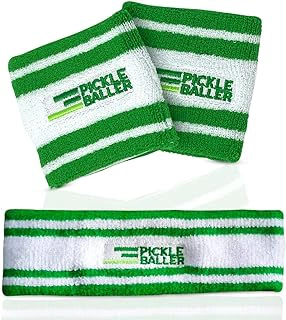
Super Fly Goods Sweatband Set for Pickleball, Golf, and Tennis
Staying comfortable during your warm up routine matters, especially when outdoor conditions add heat or moisture to the mix. The Super Fly Goods Sweatband Set for Pickleball, Golf, and Tennis offers a simple solution: one headband and two wristbands designed to absorb moisture and keep your grip stable from the first dynamic stretch through on-court drills. Rated 4.8 out of 5, this set is priced at $16.95 and works across multiple racket sports.
The headband helps manage perspiration around your forehead and temples, reducing the chance of sweat running into your eyes during arm circles or lateral shuffles. The two wristbands sit snugly on each forearm, catching moisture before it reaches your paddle hand - a small but practical benefit when you're practicing split-step timing or short volleys. The fabric construction is designed for repeated use, so you can throw the set in your pickleball bag and rely on it through warm-weather months.
Because this is a multi-sport accessory, you'll find it just as useful during golf or tennis sessions, making it a versatile addition if you cross-train. The modest price point and strong rating suggest consistent quality, and the compact size means you can carry it without adding bulk to your gear. If your warm up routine includes any high-movement drills or takes place in humid climates, this sweatband set offers straightforward comfort and grip support without complicating your pre-game preparation.
- ✅ Rated 4.8 out of 5 for consistent quality
- ✅ Includes one headband and two wristbands for full coverage
- ✅ Priced at $16.95 for accessible multi-sport use
- ✅ Absorbs moisture to help maintain paddle grip during warm ups
- ✅ Compact and easy to pack in your pickleball bag
- ⚠️ Limited verified detail on fabric composition or sizing options
- ⚠️ May require washing after each session in very humid conditions
Phase 1: General Mobility (5 Minutes)
General mobility work prepares your joints for movement by increasing synovial fluid circulation and warming the tissues around each joint. Start with your neck: tilt your head gently side to side five times, then forward and back five times, moving slowly and stopping if you feel any sharp sensation. Follow with ten slow shoulder rolls backward, then ten forward, focusing on making the largest comfortable circle you can manage.
Move to your wrists next - extend both arms and rotate your hands in circles, ten repetitions clockwise and ten counterclockwise. This is especially important for pickleball because your wrist controls paddle angle and absorbs impact during play. For your hips, stand near a wall or chair for balance and draw small circles with one knee lifted, ten circles inward and ten outward on each leg, keeping the motion controlled and smooth.
Finish with ankle circles: lift one foot slightly off the ground and rotate the ankle ten times in each direction, then switch sides. If balance is a concern, hold onto a stable surface and keep the circles small at first. End this phase with ten gentle knee lifts, alternating legs, bringing each knee to a comfortable height without forcing the range. The goal here is joint awareness and lubrication, not deep stretching - you're signaling to your body that movement is coming, which helps reduce stiffness and prepares connective tissue for the dynamic work ahead.
Pickleball for Seniors: Complete Beginner's Guide
Building a warm-up habit is easier when you understand the why behind each movement, and Pickleball for Seniors: Complete Beginner's Guide offers exactly that foundation. Priced at $9.99 and rated 5.0 out of 5, this beginner-focused resource walks through warm-up principles, technique fundamentals, and strategy tailored to older players who want a complete knowledge base before stepping onto the court.
The guide addresses warm-up routines within the broader context of senior-friendly play, helping you connect mobility drills to stroke mechanics and court positioning. If you're new to pickleball or returning after time away, this structured primer explains how each pre-game step prepares you for specific movements during rallies - linking joint preparation to pivot footwork, shoulder rolls to serving motion, and dynamic leg swings to baseline coverage.
Because it's written for beginners, the language stays accessible and avoids overly technical jargon. The 5.0 rating reflects readers' appreciation for clear explanations and practical sequencing. For players who want more than a checklist - who prefer understanding the reasoning behind warm-up choices and how they fit into a full game plan - this guide delivers that context without requiring prior experience.
Use this resource alongside your pre-game routine to deepen your grasp of why certain stretches matter and how to adjust intensity as your comfort and mobility improve over time.
- ✅ Covers warm-ups within full beginner curriculum
- ✅ 5.0/5 rating from readers
- ✅ Explains the reasoning behind movement prep
- ✅ Affordable at $9.99
- ⚠️ Book format requires reading time before play
- ⚠️ Not a quick-reference checklist
Phase 2: Dynamic Movement (5 Minutes)
Dynamic movement prepares muscles and joints for the quick directional changes and multi-plane motion pickleball demands. Spending five minutes on controlled, sport-specific patterns raises core temperature, improves range of motion, and helps the nervous system rehearse the coordination needed on court.
Leg swings are a simple way to loosen the hips and hamstrings. Stand beside the net post or fence for light support, swing one leg forward and back ten times with a relaxed knee, then switch to side-to-side swings across the body. Keep the motion smooth rather than forceful; you're waking up the hip flexors and adductors that stabilize you during split steps and lateral shuffles.
Walking lunges mimic the loading pattern of a split step and low ready position. Step forward into a lunge, lower the back knee toward the ground as far as comfort allows, then push through the front heel to stand and step into the next lunge. Aim for eight to ten lunges per leg. This movement activates glutes, quads, and calves while gently stretching the hip flexors - exactly what you need before chasing down a dink or driving to the kitchen line.
Torso rotations prepare the trunk for groundstrokes and serves. Stand with feet shoulder-width apart, arms bent at ninety degrees, and rotate your shoulders left and right in a controlled rhythm. Let your hips follow slightly but keep the motion centered in the mid-back. Ten rotations in each direction help lubricate the thoracic spine and rehearse the coiling action behind every forehand and backhand.
Arm circles warm the shoulders and improve overhead reach for serves and high volleys. Extend both arms out to the sides and draw small circles forward for ten repetitions, then reverse for ten more. Gradually increase the diameter of the circles as the shoulder capsule loosens. This drill reduces the stiffness that can limit racket-head speed and increase strain during repetitive strokes.
Each of these movements mirrors a specific demand you'll face during play: leg swings prep for wide steps, lunges simulate the split-step load, torso rotations rehearse stroke mechanics, and arm circles ready the shoulders for serves and smashes. Perform them at a tempo that feels controlled - not rushed - and notice any tightness or asymmetry. If one side feels restricted, add an extra set on that limb. The goal is to move through your available range with confidence, not to force new flexibility under time pressure.
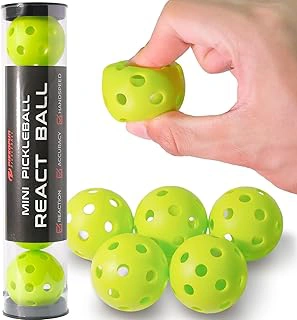
PIKKOFUN React Mini Pickleball Balls – 5 Pack 1.65" Small Pickleball Training Balls for Indoor Drills, Hand Speed & Paddle Control – Quiet Home Practice, Warm-Ups & Gifts – Lime Green
Smaller training balls add a useful challenge to the activation phase of your warm up by sharpening focus and demanding tighter paddle control. The PIKKOFUN React Mini Pickleball Balls measure the listed size in diameter - noticeably smaller than standard balls - which forces you to track a reduced target and fine-tune your hand-eye coordination before stepping onto the court.
A five-pack at $8.99 gives you enough balls for continuous drills without interruption. These mini balls work well for indoor use, staying quiet on hard floors while you practice controlled dinking, volley touch, or paddle-face tracking during the final stage of your warm up. The compact size also makes them easy to carry in a gear bag alongside your regular balls.
Because the smaller diameter requires more precision, a few minutes of mini-ball taps or wall rallies can activate fine motor pathways and boost concentration. This type of drill fits naturally after you've completed joint mobility and dynamic stretches, serving as a bridge between general movement and match-ready play. The lime green color offers good visibility against most indoor backgrounds, helping you maintain visual tracking even as your eyes adjust to the smaller sphere.
Keep in mind that the reduced size means less forgiveness on off-center hits, so start with gentle volleys and gradually increase pace as your feel improves. These training balls are not a replacement for standard court play but a supplemental tool to enhance paddle control and reaction speed during warm up routines.
- ✅ 1.65-inch diameter challenges hand-eye coordination and paddle precision
- ✅ Five-pack provides continuous drill repetitions at $8.99
- ✅ Quiet on indoor surfaces for home or gym warm up sessions
- ✅ Lime green color aids visual tracking in varied lighting
- ⚠️ Smaller size offers less forgiveness, requiring gradual pace increase
- ⚠️ Not suitable as a replacement for regulation pickleball play
Phase 3: Pickleball-Specific Activation (3–5 Minutes)
Once your muscles are warm and joints are mobile, the final phase bridges movement prep and actual play by rehearsing the specific actions you'll repeat on court. Pickleball-specific activation drills wake up paddle coordination, sharpen visual tracking, and tune the lateral balance and split-step timing that keep you stable during rallies.
Start with mini-volleys at the kitchen line: stand a few feet from the net and tap controlled volleys back and forth with a partner, keeping your paddle face steady and your feet active beneath you. This drill activates shoulder stability, wrist control, and the small corrective steps that maintain your position without rushing or lunging.
Next, practice shadow split-steps along the baseline or transition zone. Take two or three shuffle steps to your right, execute a small hop-and-land split-step, then shuffle left and repeat. The goal is to rehearse the weight transfer and ready position you'll use to react to incoming shots, reinforcing balance and ankle stability before the ball is live.
If you have a partner available, spend two to three minutes dinking softly from the kitchen line. Focus on smooth paddle motion, controlled pace, and comfortable footwork rather than winning the point. This low-intensity exchange lets you calibrate depth, spin, and spacing while your eyes adjust to ball tracking and your core engages to stabilize each stroke.
Finally, perform a few gentle overhead reach mimics: raise your paddle arm as if preparing for an overhead, then lower it in a controlled arc. Repeat four to six times on each side to activate shoulder rotation and scapular control without the impact of a full smash. These rehearsals prepare the muscles and connective tissue for the explosive movements you'll encounter during live play, reducing the gap between warm-up and full-speed rallies.
Your Complete 13–15 Minute Warm Up Sequence
- Neck rolls, wrist circles, ankle rotations (5 min)
- Leg swings, walking lunges, arm circles (5 min)
- Torso rotations and shoulder rolls (included in Phase 2)
- Mini-volleys at the kitchen line (2 min)
- Split-step practice and lateral shuffles (2 min)
- Easy dinking or overhead reach mimics (1 - 2 min)
Common Warm Up Mistakes Senior Players Make
Skipping joint mobility work before pickleball is one of the most common mistakes senior players make, and it often leads to stiffness that persists through the entire session. Walking straight onto the court without moving ankles, knees, hips, and shoulders through their range of motion leaves those joints unprepared for the quick directional changes and overhead motions the game demands. Even five minutes of arm circles, ankle rolls, and hip swings can make a noticeable difference in how comfortable you feel during the first few games.
Another frequent error is performing static stretches on cold muscles - holding a hamstring or calf stretch for 30 seconds before any movement warms the tissue. Static stretching before activity can temporarily reduce muscle power and does little to prepare your body for dynamic play. Save those longer holds for after your session, and use dynamic movements like leg swings and walking lunges during your warm up instead.
Rushing straight into full-speed rallies without a gradual build is equally problematic. Many senior players step onto the court and immediately start hitting hard drives or attempting quick volleys, which asks cold muscles and joints to perform at peak intensity without preparation. Starting with soft dinking, then progressing to controlled groundstrokes, and finally adding pace gives your body time to adapt and reduces the risk of strain or discomfort.
Neglecting shoulder activation is another gap, especially given the overhead and cross-body motions pickleball requires. Seniors who skip arm circles, band pull-aparts, or light serves often feel shoulder fatigue or tightness earlier in play. Spending two minutes on targeted shoulder movements primes the rotator cuff and surrounding muscles for the repetitive motion ahead.
The tradeoff is straightforward: saving five minutes by skipping a proper warm up often costs you comfort, confidence, and performance for the entire session. A methodical routine may feel slower at first, but it consistently delivers smoother movement and greater enjoyment once play begins.
Adjusting Your Warm Up for Joint Stiffness or Weather
Cold mornings, stiff joints, or unexpected weather all change how your body responds to warm up, so small adjustments help you prepare safely. When temperatures drop below 60°F or you wake up feeling tight, add 2 - 3 minutes of gentle mobility work before your regular routine - extra knee circles, ankle rotations, and wrist rolls help lubricate joints that cool weather makes sluggish. Spend additional time on problem areas: if shoulder stiffness shows up during overhead serves, perform 15 - 20 slow shoulder circles forward and backward; if your knees feel creaky, do two sets of marching in place and gentle leg swings before progressing to dynamic stretches. On very cold or windy days, use an indoor space - clubhouse, garage, or car park - to complete the first five minutes of your warm up, allowing your muscles to wake up in shelter before stepping onto chilly courts. If you feel unusual tightness in a specific joint, pause and add 30 - 60 seconds of slow, controlled movement through that range before asking it to handle quick pickleball footwork. These situational tweaks respect how age, weather, and daily variance affect readiness, and they reduce the chance that you skip warm up entirely just because conditions are uncomfortable. The key is recognizing that a one-size routine doesn't fit every morning: listen to your body, adjust your time and focus accordingly, and give yourself permission to spend an extra minute preparing when conditions demand it.
Final Takeaway: Make Warm Ups a Non-Negotiable Part of Your Routine
Spending 13 - 15 minutes on a structured warm up before every pickleball session is small insurance for long-term comfort, confidence, and consistent performance on the court. For senior players, this preparation is not optional - it directly affects joint readiness, movement quality, and how you feel during and after play.
The three-phase structure outlined in this guide - gentle joint mobility, dynamic stretches for the lower and upper body, and on-court activation drills - works together to prepare your muscles, lubricate your joints, and wake up the movement patterns you will use in every rally. Each phase builds on the last, progressing from controlled, low-intensity motion to sport-specific footwork and reaction drills that mirror real gameplay.
Consistency is what turns a warm up from a checklist into a habit that protects your body and improves your readiness. When you warm up the same way before every session, your body learns to expect and respond to the routine, reducing stiffness and improving coordination over time. It also builds mental confidence - you step onto the court knowing you are prepared, not guessing whether your knees, shoulders, or ankles are ready for quick lateral movement or overhead reaches.
Warm ups do not guarantee you will never feel sore or tight, but they do reduce the likelihood of avoidable discomfort and help you move with better control and stability from the first point. Make this 13 - 15 minute routine a non-negotiable part of your pickleball practice, and you will notice the difference in how your body responds, how quickly you settle into your rhythm, and how much more you enjoy the game.