We may earn a commission when you buy through links on this page, at no extra cost to you. How this works.
Before you swap shoes or cut back your court time, check what's under your feet. Most athletic shoes ship with thin foam liners that compress within weeks, leaving your arches unsupported during the rapid side-to-side shuffles and hard stops that define pickleball. When your arch collapses inward with each step, the resulting overpronation sends stress waves up through your ankle, knee, and lower back.
Orthotic insoles address this chain reaction by stabilizing your foot in a biomechanically neutral position. A firm arch shell prevents excessive pronation, while a contoured heel cup keeps your calcaneus centered during lateral lunges. Shock-absorbing layers in the forefoot and heel cushion high-impact landings without bottoming out. For players managing plantar fasciitis, the right insole reduces tension on the plantar ligament by supporting the arch and limiting overstretching during push-off.
The challenge is fit. Aftermarket insoles add 3 to 5 millimeters of stack height, so your court shoe must have removable factory liners and enough volume to accommodate the thicker footbed without pinching your toes or compressing the top of your foot.
Quick comparison
| TANSTC Plantar Fasciitis Orthotic Insoles with Heavy Duty Arch Support for Flat Feet | Check fit for your shoe size |
| Pickleball Insoles with 4D Memory Foam Arch Support, Shock Absorbing and Breathable Comfort | See current price and sizing |
| WalkHero Heavy Duty Pain Relief Insoles with High Arch Support Orthotics | Verify shoe depth before ordering |
Fit and safety come first
Use the comparison as a shortlist, but keep fit, comfort, and any health or safety constraints ahead of price.
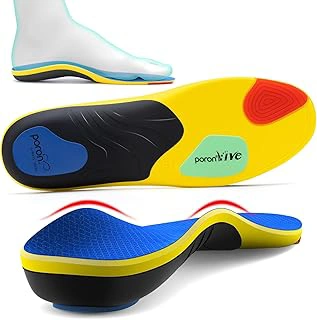
TANSTC Plantar Fasciitis Orthotic Insoles with Heavy Duty Arch Support for Flat Feet
This heavy-duty orthotic uses a rigid TPU arch shell and a 20-millimeter heel cup to stabilize flat or overpronating feet during lateral court movements. The firm arch support is noticeably taller than budget insoles, providing the structural control needed for players whose arches collapse under load. A gel pad under the heel and a metatarsal cushion zone absorb shock during hard stops and jumps.
The insole is full-length and trimmable, fitting men's sizes 8 through 13. You'll need to remove your factory liner and verify your shoe has at least 5 millimeters of vertical clearance above your toes after insertion. Hypothetically, if you play three times a week and weigh 190 pounds, this model's dense EVA base layer should resist compression for six to nine months before needing replacement.
The break-in period can last a week. Start with two-hour sessions and expect your arches to feel fatigued as stabilizing muscles adjust. The top fabric is a moisture-wicking polyester blend that stays relatively dry during multi-game sessions. Rated 4.4 out of 5, this insole suits players prioritizing motion control over plush cushioning.
- ✅ Rigid TPU shell provides firm arch stabilization for flat feet
- ✅ Deep 20mm heel cup controls overpronation during lateral moves
- ✅ Heavy-duty construction supports players over 180 pounds
- ⚠️ Firm arch requires one-week break-in period
- ⚠️ Full-length design needs shoes with removable liners and adequate depth
How Quality Insoles Provide Stability and Pain Relief
An effective orthotic insole performs three simultaneous tasks: it distributes load, controls motion, and absorbs shock. The arch support component—typically a semi-rigid thermoplastic or dense EVA shell—cradles your midfoot and prevents the longitudinal arch from flattening under your body weight. This stabilization keeps your subtalar joint in a neutral alignment, which reduces compensatory rotation at the knee and hip.
The heel cup, usually 15 to 20 millimeters deep, encases your calcaneus and limits side-to-side wobble during quick direction changes. A deeper cup offers more control but requires a shoe with adequate heel counter depth. Cushioning layers made from memory foam, gel, or polyurethane foam attenuate ground-reaction forces during landing, protecting joints and reducing fatigue over long matches.
For seniors or anyone with age-related fat-pad atrophy, forefoot cushioning becomes critical. As the natural padding under the metatarsal heads thins, every hard landing transmits directly into bone. A well-designed insole restores some of that lost protection.
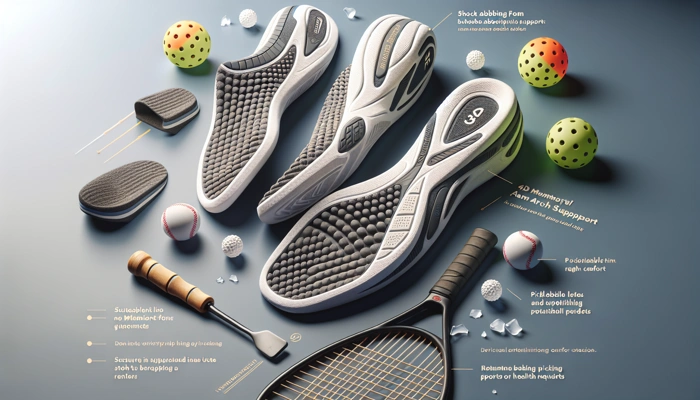
Pickleball Insoles with 4D Memory Foam Arch Support, Shock Absorbing and Breathable Comfort
Designed specifically for court sports, this insole combines a contoured arch with four-density memory foam layers that adapt to your foot shape over the first few wears. The foam is softer than rigid orthotics but still provides moderate arch lift—ideal if you have normal arches and want cushioning plus mild support. A gel insert under the heel absorbs impact during serves and overhead slams.
The breathable mesh top includes perforations that channel air and wick moisture, reducing the swampy feeling common in non-vented insoles. At $17.99, it's one of the most affordable pickleball-specific options. Hypothetically, if you're a 155-pound player with mild plantar fasciitis who values cushioning over maximum stability, this memory foam construction offers a comfortable middle ground without the aggressive arch enforcement of rigid models.
The insole is trimmable and fits most court shoe sizes. Because the foam is less dense than heavy-duty EVA, expect to replace it every four to six months with regular play. Rated 4.2 out of 5, it appeals to players seeking pickleball-targeted design at an accessible price.
- ✅ Four-density memory foam adapts to individual foot contours
- ✅ Breathable mesh top with perforations reduces moisture buildup
- ✅ Affordable pickleball-specific design at under $18
- ⚠️ Softer foam compresses faster than rigid orthotics
- ⚠️ Moderate arch support may not suffice for severe flat feet
Key Features to Look For in a Pickleball Insole
Start with arch height. If you have flat feet or low arches, look for firm arch support rated as medium to high. High arches need cushioning under the arch rather than aggressive lift. Many insoles list a weight rating—choose 'heavy duty' models if you weigh over 200 pounds, as standard-duty foam compresses too quickly under higher loads.
Check the insole length and whether it's trimmable. Full-length insoles offer forefoot cushioning but require more shoe volume. Three-quarter-length models stop just behind the ball of your foot, preserving toe-box space in snug court shoes. Verify the top fabric is moisture-wicking; polyester or antimicrobial mesh keeps your feet drier than basic foam covers.
Finally, confirm compatibility with your shoes. Remove the factory liner and measure its thickness. If the stock insole is less than 3 millimeters thick and non-removable, aftermarket orthotics will crowd your foot. Court shoes with removable insoles and a roomy fit work best.
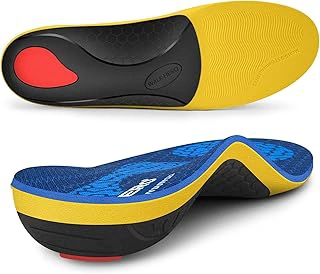
WalkHero Heavy Duty Pain Relief Insoles with High Arch Support Orthotics
WalkHero's heavy-duty model features a high-arch TPU shell and an extra-deep heel cup engineered for maximum motion control. The arch is one of the tallest in this category, making it the go-to choice for players with flat feet or severe overpronation. A dual-layer foam system combines a firm base for stability with a softer top layer for contact comfort.
The insole includes a metatarsal pad that redistributes pressure away from the ball of your foot—helpful if you experience forefoot pain after long rallies. It's full-length and trimmable, but the aggressive arch height requires shoes with generous depth. Hypothetically, if you're recovering from plantar fasciitis and need firm arch enforcement during two-hour pickleball sessions, this model's rigid support platform can help maintain neutral alignment even when your intrinsic foot muscles fatigue.
Expect a multi-day break-in. The high arch can feel intrusive at first, so limit initial wear to one hour and gradually increase. Rated 4.4 out of 5 at $17.99, it delivers orthotic-level support at a fraction of custom insole costs.
- ✅ Extra-tall TPU arch shell for severe flat foot correction
- ✅ Deep heel cup and metatarsal pad enhance stability and pressure distribution
- ✅ Heavy-duty construction at budget-friendly $17.99
- ⚠️ Aggressive arch height requires multi-day break-in
- ⚠️ Full-length design demands shoes with significant internal volume
How to Choose the Right Insoles for Your Feet and Shoes
Match the insole's arch height to your foot type. Stand barefoot and wet your foot, then step on a paper towel. If you see a complete footprint with little or no curve along the inside edge, you have flat feet and need firm, high-arch support. A moderate curve indicates normal arches; choose medium support with balanced cushioning. A narrow connecting strip means high arches—prioritize cushioning over aggressive arch lift.
Measure your shoe's internal depth before ordering. Remove the factory insole and press your thumb into the shoe bed. If there's less than 5 millimeters of space above your foot when standing, a thick orthotic will compress your toes. In that case, select a three-quarter-length model or a low-profile design.
Consider your weight and activity level. Players over 200 pounds or those playing daily should choose heavy-duty models with dense EVA or TPU construction. Lighter players can use standard-duty foam. Finally, plan for break-in. Wear new insoles for one or two hours initially, then add an hour each day until your muscles adapt to the corrected alignment.
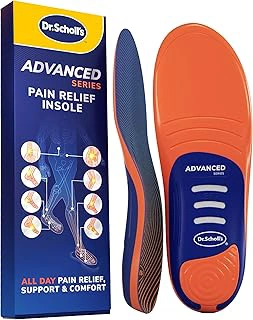
Dr. Scholl’s Advanced Pain Relief Heavy Duty Orthotics for Plantar Fasciitis & Arch Support
Dr. Scholl's brings brand recognition and clinically tested geometry to this heavy-duty orthotic designed specifically for plantar fasciitis. The insole uses a semi-rigid arch support that's less aggressive than the WalkHero but more substantial than generic foam models. A shock-absorbing heel pad and arch reinforcement work together to reduce strain on the plantar ligament during push-off.
At $39.99, it's the premium option in this lineup. You're paying for the brand's testing protocols and widely available sizing, which includes half sizes and width-specific models. The insole fits men's 8 through 14 and is trimmable. Hypothetically, if you've tried budget insoles without success and want a model backed by a major health brand, this orthotic's moderate arch and proven design might justify the higher cost.
The top fabric is treated with an antimicrobial agent to reduce odor, and the forefoot includes extra cushioning for metatarsal comfort. Rated 4.4 out of 5, it suits players who prefer established brands and are willing to invest more for a well-documented design.
- ✅ Clinically tested design backed by established health brand
- ✅ Semi-rigid arch balances support and comfort for plantar fasciitis
- ✅ Antimicrobial top fabric and wide sizing range including half sizes
- ⚠️ Premium $39.99 price point is double budget alternatives
- ⚠️ Moderate arch may under-support severe flat feet
Frequently Asked Questions About Pickleball Insoles
How long do orthotic insoles last? Heavy-duty models typically last six to nine months with regular play, while softer memory foam insoles may compress after four to six months. Replace insoles when the arch support flattens or the cushioning bottoms out.
Can I move insoles between different pairs of shoes? Yes, if both pairs have removable liners and similar internal dimensions. Wash and dry the insoles between swaps to prevent odor transfer.
Will insoles cure my plantar fasciitis? Insoles reduce strain on the plantar ligament by supporting the arch and cushioning impact, which can alleviate symptoms. However, they work best as part of a broader treatment plan that includes stretching, icing, and rest.
Do I need custom orthotics instead? Most recreational players find relief with quality over-the-counter insoles. Consider custom orthotics if you've tried multiple models without improvement or if you have significant biomechanical issues diagnosed by a podiatrist.
A Final Word on Playing Pain-Free
Quality orthotic insoles can transform your court experience by stabilizing your feet, cushioning impact, and reducing the chain of stress that travels from your arches to your knees and back. Before you click 'buy,' remove your shoe's factory liner and confirm there's enough depth for a thicker insole. Match arch height to your foot type—flat feet need firm support, while normal arches benefit from balanced cushioning.
Remember that even the best insole requires a break-in period as your stabilizing muscles adjust to corrected alignment. Start with short sessions and increase gradually. If foot pain persists beyond two weeks of proper insole use, consult a podiatrist to rule out stress fractures, nerve issues, or other conditions that need professional treatment. Insoles are a tool, not a cure-all, but for most players they're the simplest way to extend your years of pain-free pickleball.