We may earn a commission when you buy through links on this page, at no extra cost to you. How this works.
Elbow straps and compression arm sleeves tackle tendonitis through fundamentally different mechanisms, and choosing the wrong style can leave you with either too little support or too much restriction during fast exchanges at the net. An elbow strap applies focused pressure just below the painful tendon insertion, interrupting the pull that aggravates lateral or medial epicondylitis with each forehand drive. A compression sleeve wraps the entire joint in graduated fabric tension, stabilizing the elbow through its full range while you reach for high volleys or reset dinks. For senior players managing chronic tendonitis, the distinction matters because joint mobility, skin sensitivity, and the specific location of your pain determine whether targeted counterpressure or continuous compression will feel more comfortable through a two-hour session.
Strap designs work best when pain concentrates on the outer or inner bump of the elbow and flares during specific strokes - backhand slices or topspin forehands - where tendon load peaks suddenly. Sleeve designs suit diffuse soreness around the joint, mild swelling after long matches, or situations where you want consistent support without adjusting hardware between games. Fit becomes more critical as skin loses elasticity: a strap that migrates down the forearm loses its mechanical advantage, while a sleeve that rolls or pinches can distract you mid-rally. This guide walks through how each product style actually works, the tradeoffs in coverage and adjustability, and the fit details that separate functional support from gear you'll leave in your bag.
You will see side-by-side comparisons of pressure zone, ease of position adjustment, breathability under sun exposure, and compatibility with the forearm muscle engagement that senior players rely on for paddle control. By the end, you will understand which design aligns with your pain pattern, how often you play each week, and whether your priority is pinpoint tendon relief or general joint stability during longer tournament formats.
Fit and safety come first
Use the comparison as a shortlist, but keep fit, comfort, and any health or safety constraints ahead of price.
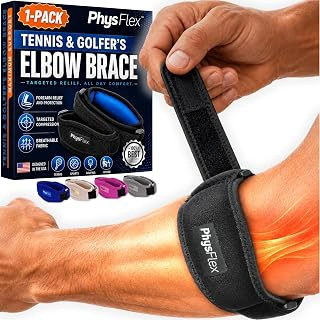
Tennis and Golfer's Elbow Brace Support Strap with Compression Pad
The Tennis and Golfer's Elbow Brace Support Strap positions a compression pad one inch below the elbow joint to apply focused pressure on the forearm muscles. This targeted design suits seniors whose pain flares primarily during backhand strokes or when gripping the paddle tightly, since the pad directs compression to the tendon attachment area rather than covering the entire forearm.
The adjustable hook-and-loop strap allows you to fine-tune tension around your forearm circumference, which matters for older players whose arm size may change throughout the day due to swelling or fluid retention. You can loosen the strap between games and retighten when soreness increases, giving you control over compression level without removing the brace entirely.
At $15.99, this strap offers an affordable entry point if you want to test whether localized compression helps your specific pain pattern before investing in a full-length sleeve. The 4.4 out of 5 rating reflects consistent performance, though the single-pad design means you must place it correctly - too high or too low reduces effectiveness. Measure the distance from your elbow crease to where you feel the most tenderness, then position the pad at that spot and adjust the strap snugly but not tight enough to cut circulation.
This brace works best for players who experience discomfort in a defined area rather than diffuse forearm aching. If your pain radiates widely or shifts location between the inner and outer forearm, a compression sleeve may provide more uniform support. Before ordering, confirm your forearm circumference at the spot where the strap will sit, and check the product page for the sizing range to ensure a secure fit that stays in place during overhead smashes and cross-court dinks.
- ✅ Compression pad delivers focused pressure to the tendon attachment point
- ✅ Adjustable strap lets you change tension throughout play or between matches
- ✅ Budget-friendly option for testing whether localized compression suits your pain pattern
- ⚠️ Single-pad design requires precise placement to target the correct area
- ⚠️ May shift during play if forearm circumference falls outside the sizing range
- ⚠️ Provides less coverage than a full sleeve if pain is diffuse or moves
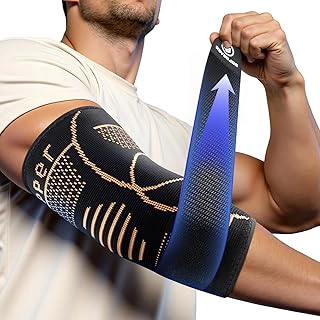
Copper Elbow Compression Sleeve & Brace with Adjustable Strap for Tennis Elbow & Tendonitis
The Copper Elbow Compression Sleeve & Brace with Adjustable Strap offers a hybrid approach for seniors who want both sleeve coverage and focused strap pressure. Priced at $18.03 with a 4.2/5 rating, this design wraps the elbow joint in copper-infused fabric while adding an adjustable strap that sits over the forearm tendon insertion point. The combination lets you dial in compression where lateral or medial tendons are most tender without sacrificing warmth around the elbow itself.
Copper-infused fabric claims center on odor control and fabric longevity rather than performance enhancement, so expect this material to behave like standard compression knit with slightly different texture. The sleeve portion keeps the joint warm during long rallies, which some players find helpful for stiffness, while the strap adds the targeted squeeze that a full sleeve alone cannot provide. For seniors managing both general elbow discomfort and a specific tendon hot spot, this dual-mechanism design can be more versatile than choosing one style or the other.
Sizing accuracy is critical: measure both mid-forearm circumference and the widest part of your upper forearm, since bunching or rolling at either edge will undermine the strap's stability. The strap closure must overlap enough to hold tension without digging into skin, so if your arm tapers sharply or swells during play, plan to verify the return policy before committing. Seniors with limited hand strength should test the strap fastener while seated to confirm they can adjust it independently between games.
Compared to a standalone strap, this sleeve adds coverage and a second layer over the rest of your arm, which can feel restrictive in warm weather or under long-sleeve shirts. Compared to a plain compression sleeve, the integrated strap provides the focal pressure that reduces load on inflamed tendon fibers during each swing. If your pain moves between the inner and outer elbow or you play multiple times per week in variable conditions, the hybrid layout offers more adjustment than either single-function design. Make sure your measurements fall cleanly within one size bracket, and remember that the strap works only if the sleeve sits snugly enough to anchor it.
- ✅ Combines sleeve warmth with adjustable strap for targeted tendon compression
- ✅ Hybrid design suits players managing both general elbow stiffness and focal tendon pain
- ✅ Priced at $18.03, offering two-function support in one piece
- ⚠️ Sizing errors cause bunching or rolling that destabilizes the strap
- ⚠️ Extra fabric layer can feel warm or restrictive in hot conditions
- ⚠️ Strap fastener requires adequate hand strength to adjust independently
Understanding Senior Pickleball Tendonitis (Tennis Elbow)
Lateral epicondylitis, commonly called tennis elbow, develops when the tendons connecting forearm muscles to the outer elbow experience repetitive strain. In pickleball, the two-handed backhand and frequent dinking motions demand sustained forearm extensor engagement, creating micro-tears in the tendon tissue at the lateral epicondyle. Unlike acute injuries, tendonitis builds gradually as the cumulative load exceeds the tendon's ability to repair between sessions.
Senior players face distinct challenges because tendon vascularity decreases with age, slowing nutrient delivery and collagen renewal. A 45-year-old player might recover from a heavy weekend in three days, while a 68-year-old with identical play may need seven to ten days for the same tissue adaptation. This delayed recovery window means inflammation can persist from one play session to the next, compounding strain rather than resolving it.
Pain typically appears on the outer elbow and radiates down the forearm, sharpest during backhand shots, paddle grip, or lifting objects with the arm extended. Many seniors first notice a dull ache after court time that intensifies during daily tasks like turning doorknobs or pouring coffee. The discomfort often feels manageable during warm-up rallies but escalates during the second or third game as fatigued muscles shift more load onto the already irritated tendon insertion.
Pickleball's rapid volleys and quick-reaction dinks require constant forearm stabilization, meaning the extensor muscles rarely rest during active play. This continuous low-grade tension prevents the micro-recovery intervals that help during activities with more varied movement patterns. Court surface and paddle weight also influence tendon load: hard courts transmit more vibration than cushioned surfaces, and head-heavy paddles increase the rotational torque absorbed by the forearm.
External support tools address this mechanical reality by altering force distribution across the forearm and elbow. Compression sleeves apply graduated pressure along the muscle belly, while elbow straps create a focal counterpressure point just below the tendon insertion. Each design changes how strain travels through the kinetic chain, but neither replaces the underlying need for load management and tissue adaptation. Understanding where your pain starts, how it progresses during play, and which movements trigger the sharpest response will guide which support style aligns with your specific strain pattern.
How Elbow Straps Work: Targeted Pressure on the Forearm Tendon
An elbow strap uses a counterforce mechanism to address tendon pain at its source. The narrow band - usually one to two inches wide - wraps around the forearm about one inch below the elbow joint, positioning a small compression pad directly over the extensor muscle group. When you tighten the strap, that pad applies focused pressure to the muscle belly, creating a secondary anchor point that reduces the force transmitted through the inflamed tendon insertion at the lateral epicondyle.
This design redistributes mechanical load during gripping and wrist extension. Instead of the full strain concentrating at the already irritated attachment site, the strap intercepts part of that tension farther down the forearm. The effect is most noticeable during backhand strokes, dinking exchanges, and paddle grip adjustments - movements that typically aggravate the outer elbow.
Fit mechanics matter. Most straps use hook-and-loop fasteners that allow quick tension changes between points or games. You want firm contact without cutting off circulation; the pad should sit snugly over the muscle without sliding during play. Adjustment range varies by model, so measure your forearm circumference about two inches below the elbow crease to confirm compatibility before ordering.
This targeted approach works well when pain stays localized to the outer elbow and worsens with specific gripping motions. If discomfort spreads into the upper forearm or bicep, or if you need broader muscle support during longer play sessions, the single-point pressure of a strap may feel insufficient.
Pros and Cons of Elbow Straps for Senior Players
Elbow straps deliver focused compression one inch below the elbow joint, applying pressure directly to the forearm muscle-tendon junction where repetitive paddle swings often trigger discomfort. For senior players who need relief without sacrificing mobility, this low-profile design stays out of the way during fast exchanges at the net and does not restrict your arm swing or paddle grip.
The single-strap design makes mid-match adjustments straightforward: you can tighten or loosen tension between games without removing the strap entirely. This matters when morning stiffness eases after a few rallies or when humidity changes how snugly the strap fits. Lightweight construction adds no noticeable weight, and the narrow band does not interfere with elbow flexion or extension through a full range of motion.
Correct placement takes practice. The strap must sit one inch below the bony prominence of your elbow - too high and it presses into the joint itself, too low and compression misses the target zone. Players with limited hand dexterity may need help threading the strap through the loop initially, though most straps use hook-and-loop closures that simplify daily use once you learn the correct position.
Perspiration introduces slippage risk. A strap that feels secure during warm-up can migrate downward as sweat coats your forearm, reducing the pressure where you need it most. Some designs incorporate silicone grippers or textured inner linings to counteract this, but skin that bruises easily or reacts to adhesive-backed materials may find these features irritating over long play sessions.
The single-point compression model works best when your discomfort centers on a specific spot rather than spreading across the entire forearm or up into the upper arm. If pain radiates widely or if you experience general forearm fatigue from extended play, a strap's narrow focus may not address the full area that needs support.
How Compression Sleeves Work: Full-Joint Support and Muscle Stability
Compression sleeves cover the elbow joint from mid-bicep to mid-forearm, using graduated fabric tension that is typically tighter at the lower forearm and gradually lighter toward the bicep. This design distributes pressure across the entire joint capsule and surrounding musculature, rather than isolating a single point like a strap does.
The sleeve's even compression encourages blood flow through a larger surface area, which can help manage swelling and warmth in the joint. Because the fabric wraps the arm continuously, it stabilizes lateral and rotational movement during the swing, making it useful for players who notice pain not just at the tendon insertion but across the outer elbow or deeper in the joint.
Sleeves work well when pain feels diffuse or when you have mild joint instability - such as a sense that your elbow "gives" during hard volleys or when you return a fast serve. The fabric also keeps the muscles around the elbow warm throughout play, which some players find helpful during early-morning matches or cooler weather sessions.
The tradeoff is fit: a sleeve must be snug enough to compress effectively but not so tight that it restricts circulation or bunches during arm flexion. Sleeve sizing is usually based on forearm circumference at the widest point, so measuring accurately matters. If the fabric rolls, slides, or leaves red marks that last more than a few minutes after removal, the fit is off.
For seniors managing tendonitis alongside mild arthritis or a history of elbow soreness that moves around the joint, a compression sleeve offers broader mechanical support than a strap, though it will not concentrate pressure at the tendon like a strap can.
Pros and Cons of Compression Sleeves for Senior Players
Compression sleeves offer even, consistent pressure from wrist to bicep, giving the elbow joint stability during every phase of a pickleball swing - serve, dink, and overhead smash. That continuous support can help the joint feel more secure when you change direction quickly or extend your arm for a volley, and the snug fabric keeps muscles warm throughout your match. Once you pull the sleeve on and confirm it stays in place, you can focus on play rather than fiddling with straps between games.
Heat retention is the most common complaint among senior players, particularly in outdoor summer sessions. The fabric that delivers compression also traps warmth against your skin, and during a three-game set in direct sun, that extra layer can feel uncomfortable or cause perspiration to pool. If you have thinner skin or take medications that affect circulation, the added warmth may feel more pronounced.
Sizing must be precise. A sleeve that is too loose will slide down your forearm during play, bunching at the wrist and leaving the elbow without meaningful support. A sleeve that is too tight can restrict blood flow, cause tingling, or leave red marks that take time to fade - skin fragility becomes a real concern as you age. Measuring your arm circumference at the forearm, elbow, and upper arm before ordering is essential, and many players find the pull-on design harder to manage than a hook-and-loop strap if arthritis limits hand strength or shoulder mobility.
On the upside, a full-length sleeve shields more skin from ultraviolet exposure, which matters if you play outdoors regularly and want to reduce sun damage. The fabric also stays put without the pressure point of a single strap, distributing load across a broader area and avoiding the localized squeeze some players find irritating. If you value consistent, low-maintenance support and play most often in climate-controlled or cooler conditions, a well-fitted compression sleeve can become an invisible part of your gear.
Head-to-Head Comparison: Pain Relief, Comfort, and Prevention
Choosing between a compression sleeve and an elbow strap comes down to how you experience discomfort and what you need most during play. An elbow strap focuses pressure on a single point just below the joint, which makes it useful for sharp, localized soreness at the tendon attachment. A compression sleeve spreads support across the entire forearm and elbow, which suits broader aching or fatigue that radiates through the arm.
For quick relief during a match, the strap usually wins. You can tighten or loosen it between games without removing it, and the targeted pressure can reduce the pull on the tendon during overhead smashes or backhand volleys. The sleeve requires a snug fit from the start and stays put, so adjusting mid-session means rolling it down or peeling it off entirely.
Comfort over two or three hours tilts toward the sleeve. The distributed compression doesn't dig into one spot, and moisture-wicking fabric keeps the arm cooler than a concentrated strap. Players with sensitive skin or those who bruise easily often find the sleeve less irritating. The strap, though lighter and less restrictive, can feel tight or rub if positioned incorrectly.
For prevention during regular play, the sleeve offers more consistent support across the muscles and tendons involved in repetitive motions. It encourages better arm alignment and can reduce the small vibrations that travel up the arm after each paddle strike. The strap excels when soreness is already present and you need to limit stress on a specific tendon, but it won't do much for overall arm stability or warm-up.
If you play daily or multiple times a week, the sleeve's broader coverage and all-day wearability make it easier to build into your routine. If you only feel discomfort during certain shots or after long rallies, the strap's precision and adjustability give you control exactly when you need it.
The Verdict: When to Choose a Strap vs. a Sleeve
Choosing between an elbow strap and a compression sleeve comes down to three practical factors: where you feel discomfort, how much coverage you prefer, and what your typical pickleball session looks like.
If your discomfort is sharp and concentrated on the outer elbow - especially when you grip the paddle or hit backhands - an elbow strap delivers focused pressure exactly where the tendon attaches to bone. That targeted design keeps bulk to a minimum and lets you tighten or loosen the strap between games without pulling off the entire piece. Many players find straps easier to adjust when switching from warm-up drills to match play.
Compression sleeves make more sense when discomfort feels diffuse, spreading across the joint or running into the upper forearm. The sleeve's graduated fabric applies gentle, even pressure along a larger area, which can improve circulation and add a layer of warmth that some seniors find soothing during longer play sessions. Sleeves also provide light stability around the entire elbow, which may help if you notice the joint feels wobbly or fatigued after repeated overhead shots.
Fit matters, too. Straps work well if you have fuller arms or find elastic cuffs uncomfortable; most straps use hook-and-loop closures that accommodate a range of circumferences. Sleeves require accurate sizing and can roll or bunch if they're too loose, or cut in if they're too tight - measure your forearm and elbow circumference before ordering.
A small but growing number of sleeves now include an integrated pressure pad or removable strap sewn into the fabric. These hybrid designs let you combine the warmth and coverage of a sleeve with the focused compression of a strap, though they tend to cost more and add a bit of complexity during washing and storage.
In practice, many players keep both styles in their bag. Start with the design that matches your primary pain pattern, wear it during a few light games, and pay attention to whether the support stays in place and feels comfortable after fifteen or twenty minutes of play. That real-world feedback will guide your choice better than any single feature list.
Other Essential Tips for Managing Elbow Pain On and Off the Court
Support gear like compression sleeves and elbow straps work best when paired with smart play habits and off-court recovery strategies. Warm up wrists and forearms with gentle stretches before each session to prepare tendons for repetitive motion. Use a paddle with a larger grip circumference to reduce forearm strain during extended rallies. Take rest days between play sessions to allow tendon recovery, particularly if you notice soreness after court time.
Apply ice to the elbow for 15 minutes after play if pain flares, and consider reducing backhand slice shots until pain subsides, since that motion places significant stress on the lateral elbow. If pain persists beyond two weeks of modified play, consult a physical therapist who can assess your swing mechanics and recommend targeted exercises. No elbow support device replaces proper technique, adequate rest, or professional guidance when pain becomes chronic.