We may earn a commission when you buy through links on this page, at no extra cost to you. How this works.
Tracking a fast-moving pickleball becomes harder as your eyes age, not because vision loss is inevitable, but because contrast sensitivity and motion processing naturally change over time. The ball that worked perfectly a decade ago may now blend into the court surface or disappear against bright sky, forcing you to react late or misread spin.
Choosing the right pickleball ball for older eyes means prioritizing visibility factors - color saturation, contrast against common backgrounds, and how the ball behaves under different lighting conditions - over traditional performance specs like bounce consistency or durability. A ball that meets tournament standards but vanishes in your sight line won't help your game.
This guide walks through the specific attributes that affect how easily you can see and track a pickleball during play. You'll learn which colors offer the strongest contrast on typical court surfaces, how hole pattern and finish influence visibility in motion, and how indoor versus outdoor lighting changes what works best. The goal is to match ball characteristics to the way your eyes actually process visual information on the court, so you can focus on strategy and shot placement instead of straining to locate the ball.
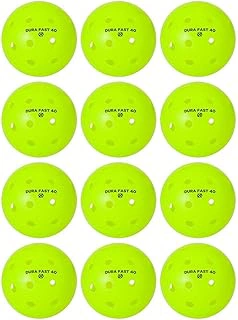
Dura Fast 40 Outdoor Pickleballs, Neon, USAPA Approved, 12-Pack
When you've confirmed that neon yellow enhances visibility on your local courts, buying in bulk saves both money and the inconvenience of frequent reorders. The Dura Fast 40 Outdoor Pickleballs deliver USAPA-approved performance in a 12-pack format priced at $17.99, which works out to about the listed cost per ball - a practical choice for players who rotate fresh balls regularly or share with a practice group.
The high-saturation neon finish offers strong contrast against most outdoor backgrounds, especially helpful for aging eyes that benefit from vivid color against green, blue, or gray court surroundings. Because this is a single-color pack, it's best suited for players who have already tested neon yellow in varying light conditions and found it consistently easier to track than white or pastel alternatives.
USAPA approval confirms the balls meet official standards for weight, diameter, bounce, and hardness, so they'll behave predictably during rallies and won't introduce irregular flight paths that make tracking harder. The 4.4-rating reflects generally positive feedback on durability and consistent play characteristics across the dozen balls in the pack.
The tradeoff is commitment: purchasing twelve of the same color means you won't have variety if lighting shifts throughout the day or if you occasionally play indoors. If your vision responds better to orange or you want to test multiple colors side by side, a smaller mixed pack or single-color four-pack offers more flexibility. But for seniors who've already identified neon yellow as their go-to visibility choice and want dependable stock on hand, this bulk option delivers proven performance at a lower per-unit cost.
- ✅ USAPA approved for official weight, diameter, bounce, and hardness standards
- ✅ High-saturation neon yellow provides strong contrast on most outdoor courts
- ✅ $17.99 for 12 balls - approximately $1.50 per ball - offers bulk value
- ✅ Consistent play characteristics across the pack reduce tracking surprises
- ⚠️ Single-color commitment limits flexibility if lighting conditions vary
- ⚠️ Not ideal for players still testing which hue works best for their vision
- ⚠️ Outdoor-specific construction may not suit indoor play needs
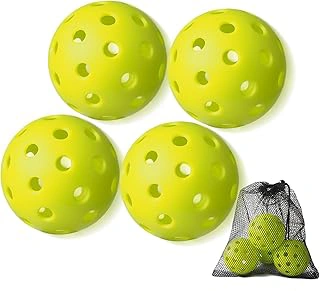
YHLOJIX 4-Pack Outdoor Pickleball Balls with Mesh Bag, 40-Hole
For seniors exploring which ball color and construction work best for their vision, the YHLOJIX 4-Pack Outdoor Pickleball Balls offers a low-cost entry point at $5.99. The four-ball set comes with a mesh carry bag and uses the standard 40-hole outdoor design, making it easy to test different lighting conditions and court backgrounds without committing to a twelve- or twenty-four-pack. With a 4.6 out of 5 rating, users report solid durability for casual outdoor play, though some note slight variations in seam quality between balls in the pack.
The affordable price makes this set practical for trying multiple balls side by side - compare how a bright ball tracks against sky versus pavement, or rotate fresh balls in and out to see how scuffing affects visibility over time. The included mesh bag simplifies transport and keeps balls together between sessions, a helpful detail for seniors managing multiple pieces of gear. Because the pack is small, it's ideal for experimenting before investing in larger quantities of a specific color or brand once you identify what your eyes track most reliably.
Keep in mind that at this price point, consistency can vary slightly ball to ball, so inspect seams and roundness when the pack arrives. For seniors prioritizing budget-friendly exploration over tournament-grade uniformity, this four-pack delivers a straightforward way to learn your visibility preferences on real outdoor courts.
- ✅ Low $5.99 price point for testing visibility preferences
- ✅ Includes mesh carry bag for easy transport
- ✅ Standard 40-hole outdoor construction
- ✅ Four-ball count allows side-by-side comparison
- ⚠️ Some users note slight seam or roundness variation between balls
- ⚠️ Smaller pack size means fewer spares if one is lost
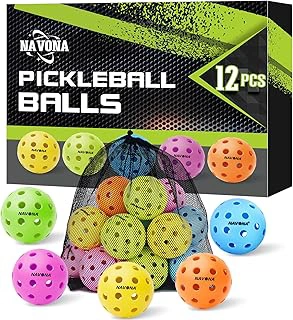
Navona 12-Pack Colorful 40-Hole Outdoor Pickleball Balls, USAPA Approved
The Navona 12-Pack Colorful 40-Hole Outdoor Pickleball Balls offer seniors the chance to test multiple ball colors in real play without committing to a single shade. At $14.99 for twelve USAPA-approved balls, the pack includes a variety of colors that let you compare visibility across different court backgrounds, sky conditions, and times of day. Each ball features the standard 40-hole outdoor design and carries official approval, so you can experiment with color preferences while maintaining tournament-legal construction.
This multi-color approach addresses a core challenge for aging eyes: what works on a green court under morning shade may disappear against the same surface in bright afternoon sun. By rotating through the pack's colors during practice sessions, you can identify which hues offer the sharpest contrast on your home court and which fade into the background. The variety also helps when playing on unfamiliar courts, since you can choose a ball that stands out against that venue's specific surface and lighting.
The pack's USAPA approval confirms each ball meets official size, weight, bounce, and hole-count standards, so visibility testing happens under consistent performance conditions. The 4.4 rating reflects broad user satisfaction, though individual color preferences will vary based on your court environment and personal contrast sensitivity. Durability and bounce consistency match typical outdoor balls in this category; the value lies in the color selection rather than extended lifespan for any single ball.
If you're uncertain which color will help you track the ball most reliably, or if you play on courts with varying backgrounds, this pack turns the guesswork into hands-on comparison. The cost per ball remains low enough that dedicating different colors to different court conditions becomes practical. For seniors prioritizing visibility experimentation within an approved ball format, the Navona 12-pack delivers the range needed to find your optimal match.
- ✅ Multiple colors let you compare visibility across different courts and lighting conditions
- ✅ USAPA approval ensures consistent performance standards across all colors
- ✅ Low cost per ball at $14.99 for twelve makes color testing affordable
- ⚠️ Color preferences vary by individual and court, requiring trial to identify best option
- ⚠️ Durability typical of standard outdoor balls; no extended lifespan claims
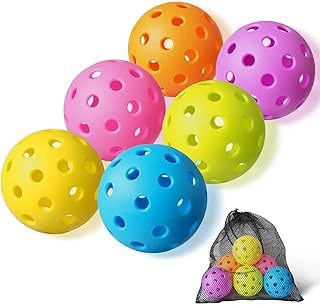
FASIUCHOI 6-Pack Colorful Outdoor Pickleball Balls with Mesh Bag, 40-Hole
Finding the right number of balls to test different colors without overbuying can be tricky. The FASIUCHOI 6-Pack Colorful Outdoor Pickleball Balls offers a middle ground between small trial sets and bulk packs, priced at $7.99 with a 4.6/5 rating. This set includes six balls in assorted colors with a mesh storage bag, giving you enough variety to compare visibility across different lighting conditions without committing to a full dozen.
Each ball features the standard 40-hole outdoor construction designed for durability on hard courts. The included mesh bag makes it easy to carry your selection to the court and keeps the balls organized when testing which colors work best for your vision. At about the listed cost per ball, the pack sits between budget four-packs and larger sets, providing enough options to identify your preferred high-contrast color without excess inventory.
The colorful assortment in this six-pack lets you directly compare how different hues appear against your typical court surface and sky background. If you've struggled to track standard yellow or white balls, having multiple color options in one affordable set helps you pinpoint which shade offers the clearest visibility for your eyes. The mesh bag also helps reduce the chance of losing track of individual balls between practice sessions, keeping your color experiment organized from the first serve to the final match.
- ✅ Six-ball count balances variety testing with reasonable cost at $7.99
- ✅ Multiple colors allow direct visibility comparison in one pack
- ✅ Mesh bag included for organized storage and transport
- ✅ 40-hole outdoor construction for standard play durability
- ⚠️ Color assortment may not include every high-visibility shade you want to test
- ⚠️ Mid-size pack may still leave you with unused colors after identifying your preference
Who This Guide Is For
This guide is for senior pickleball players who notice they're losing the ball in flight more often than they used to - whether that means delayed reaction time during fast exchanges, trouble tracking the ball against busy backgrounds, or difficulty seeing it clearly when moving between bright sun and shaded courts. If you experience eye fatigue after longer rallies or find yourself squinting to follow the ball during overhead shots, these recommendations can help.
We're not addressing vision correction or medical eye care. Instead, this guide focuses on choosing balls with color, contrast, and construction characteristics that work better with age-related changes in vision, such as reduced contrast sensitivity, slower light adaptation, and decreased ability to track fast-moving objects. The goal is to select equipment that makes the ball easier to see and follow with the eyesight you have today, so you can react faster, play more confidently, and reduce the visual strain that cuts sessions short.
Whether you play recreationally a few times a week or compete regularly in senior tournaments, the right ball choice can make a measurable difference in how comfortably you track play and how quickly you pick up the ball out of your opponent's paddle.
What Makes a Pickleball Easier to See
A pickleball is easier to see when it delivers high color saturation, strong contrast against the playing environment, and a hole pattern that creates visual weight without distraction. For aging eyes that lose contrast sensitivity and motion-tracking speed over time, these three factors determine whether the ball stands out clearly or fades into the background during fast exchanges.
Color saturation refers to how vivid and pure the ball's hue appears. Neon yellow and bright orange balls offer higher saturation than pastel or dull versions of the same color, making them pop visually even in peripheral vision. Pastel pickleballs may look appealing off the court, but their muted tones blend more easily with sky, fencing, and court surfaces, especially in flat or overcast light.
Contrast is the difference between the ball and its background. A neon yellow ball contrasts sharply against blue or green courts and darker fencing, while the same ball may disappear against a bright sky or pale concrete. Orange balls perform well against greenish courts and overcast skies but can blend into red or terracotta surfaces. Multi-color balls - split into two or three bright panels - create their own internal contrast, which helps the eye lock onto the sphere even when one panel matches the background.
Hole pattern influences how the eye perceives the ball's outline and rotation. Larger, evenly spaced holes create a consistent visual silhouette that is easier to track, while smaller or irregular holes can make the ball appear lighter or less defined. Some players find that watching the holes rotate helps them read spin and trajectory, but this requires sharp near-tracking ability that may fade with age. A clean, symmetrical hole layout supports faster recognition without adding visual clutter.
Choose balls that combine saturated color with predictable contrast in your typical playing conditions, and favor hole patterns that present a bold, stable outline rather than fine detail.
How to Choose the Right Color for Your Court and Lighting
The best pickleball ball color depends on your specific court surface and lighting conditions, not on a universal rule. Neon yellow balls deliver the strongest visibility on blue or green courts under full sunlight because the bright yellow contrasts sharply against cool-toned backgrounds and reflects abundant light. When you play in partial shade, under trees, or on overcast days, that same neon yellow can fade into dappled shadows or pale sky, making orange, lime, or hot pink better choices because their warmer or punchy tones maintain contrast even when light levels drop.
Gray, tan, or concrete court surfaces flip the equation: neon yellow may blend into neutral backgrounds, especially indoors under fluorescent or LED fixtures, while high-visibility orange or lime green stands out more clearly. If your play rotates between multiple courts or times of day, carrying a variety pack of colors lets you test two or three options in real conditions without committing to a full dozen of one shade. Pay attention to which color you lose least often during rallies - that practical feedback is more reliable than any packaging claim.
Indoor lighting adds another variable. Warm incandescent or sodium-vapor lamps can wash out yellow and make orange glow, while cool LEDs may do the opposite. The takeaway is to match ball color to the specific combination of court surface tone and light temperature you encounter most often, and keep a backup color on hand when conditions change.
Common Mistakes to Avoid When Choosing for Vision
Many players purchase a full dozen pickleball balls in one color without first testing how well they can track that shade against their most-played court surface, resulting in wasted money and continued visibility frustration. This trial-free approach often leaves seniors stuck with balls they struggle to see, especially when lighting conditions change throughout the day.
Choosing white or pastel-colored balls because they feel traditional or familiar creates serious contrast problems on light-colored courts and in bright outdoor sunlight, making the ball harder to follow during fast exchanges. White balls particularly disappear against concrete or light asphalt surfaces, forcing players to rely on sound and anticipation rather than clear visual tracking.
Another common pitfall is ignoring the contrast between ball color and court surface - a neon yellow ball that stands out beautifully on an indoor gym floor may blend into an outdoor green or tan court, while a bright orange ball can vanish against terracotta or red surfaces. Always consider the specific color and texture of the courts where you play most often, since a ball that works well in one environment may create visibility challenges in another.
Assuming indoor balls will perform equally well outdoors leads to disappointment, because indoor balls typically have larger, fewer holes that create a different flight pattern and visual profile in bright sunlight and wind. Outdoor balls feature smaller, more numerous holes that affect how shadows and light pass through, changing the way your eyes perceive the ball's position and speed.
The most effective strategy is to start with a variety pack or purchase small quantities - three to six balls - in two or three high-contrast colors, then test each during actual play sessions at different times of day. This test-then-commit approach lets you evaluate real-world visibility under your typical conditions before investing in a full supply, ensuring you choose balls that genuinely improve your ability to track and react during play.
How to Test and Compare Ball Visibility
The best way to find the right ball for your vision is to test different colors during actual play, not just by looking at them in your hand. Bring a variety pack containing yellow, orange, and white balls to your usual court time and rotate through them during warm-up rallies and games. Pay attention to which color you can track most easily when the ball moves quickly across your field of vision, especially during fast exchanges at the kitchen line where reaction time matters most.
Test each color during the lighting conditions you typically play in - morning sun, bright midday overhead light, or late afternoon shadows all affect visibility differently. A ball that stands out beautifully at 10 a.m. may blend into the background at 5 p.m. when the sun is lower. Spend at least a few volleys with each color so your eyes can adjust and you can notice which one requires less effort to follow.
Ask your playing partners for feedback on which balls they see best, particularly if they're in a similar age range or share vision concerns. Their observations can confirm your own experience or reveal colors that work well for mixed groups. Note which color you lose track of least often during serves, lobs, and overhead shots where the ball moves against the sky or court fencing.
Keep a simple record - mental or written - of which ball color felt easiest to track in each session, and over a week or two a clear preference will usually emerge based on your specific eyes, court, and schedule.
Final Takeaway: Start with Variety, Then Commit
Choosing the right pickleball ball for senior eye vision starts with testing multiple colors in the conditions where you actually play. Buy a small variety pack - four, six, or twelve balls in different colors - and rotate them through morning, midday, and late-afternoon sessions on both light and dark court surfaces. Track which color remains easiest to follow during fast exchanges, dinking rallies, and overhead lobs, paying attention to how your eyes respond when fatigue sets in or lighting shifts.
Once you identify your best-performing color, commit to that shade for practice and league play by purchasing a larger quantity. Visibility is deeply personal: one player may track neon yellow effortlessly while another loses it against certain backdrops or under specific sun angles. Court surface color, time of day, sky conditions, and your individual contrast sensitivity all interact, so no single ball works optimally for every senior eye in every situation.
Keep a few backup colors on hand for unusually bright days, heavily shaded courts, or when you notice your primary choice blending into the environment. This flexible approach - start small, test deliberately, then standardize around what works - gives you the confidence that the ball you're tracking is the one your eyes can reliably see, point after point.
Key Visibility Features to Look For
- High-saturation neon colors (yellow, orange, lime green)
- Strong contrast against your most-played court surface color
- 40-hole standard construction for consistent visibility in spin
- USAPA approval ensures uniform size and weight for predictable flight
- Multi-color options for testing personal contrast preference