We may earn a commission when you buy through links on this page, at no extra cost to you. How this works.
Driveway practice gives senior players control over timing, rest, and pace - three things that become harder to manage on crowded public courts. When you can practice at home, you skip the wait for open court time, work on footwork and consistency without pressure, and build muscle memory through short, frequent sessions that protect joints better than marathon weekend games.
The challenge is finding a net that one person can carry, set up without wrestling with poles or guy-lines, and trust to stay in place during volleys and serves. Weight matters: anything over 25 pounds becomes a strain to move from garage to driveway. Stability matters just as much, because a net that shifts or tips interrupts rhythm and creates frustration. Setup complexity is the third filter - if assembly requires more than a few minutes or demands two sets of hands, it won't get used.
This guide compares four portable pickleball nets on the attributes that affect daily use: carry weight, frame design, base stability method, packed size, and solo setup time. Each option trades off differently between regulation height, footprint, and portability. The goal is to match your driveway space, physical comfort with lifting and bending, and how often you'll move the net between sessions.
Quick comparison
| BAGAIL Portable 22 FT Regulation Size Pickleball Net Set | Check current price and customer setup reviews |
| Fostoy Portable 3-in-1 Pickleball Net Set with Wheels | See wheel design and transport details |
| Hoverphenix Portable 22FT Regulation Size Pickleball Net Set | View frame specs and outdoor durability notes |
Fit and safety come first
Use the comparison as a shortlist, but keep fit, comfort, and any health or safety constraints ahead of price.
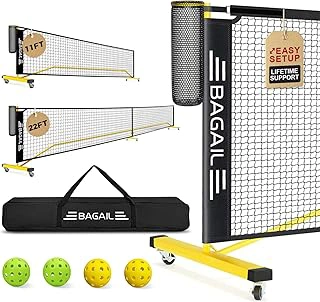
BAGAIL Portable 22 FT Regulation Size Pickleball Net Set
Players who want regulation dimensions for home practice without compromising on court feel will find the BAGAIL 22-foot net delivers full-width coverage at a manageable price point. Stretching the complete 22-foot width means you can work on crosscourt dinks, wide serves, and lateral movement patterns exactly as they play on tournament courts, making this net particularly useful if your driveway can accommodate the span.
The frame uses a sectional pole design that connects at multiple joints. Setup requires threading the net through sleeves and securing tension straps at each post, a process that takes roughly fifteen minutes once you understand the sequence. The 4.6 rating suggests most users successfully complete assembly, though first-time setup may involve consulting the included instructions to align pole sections correctly. Once erected, the structure holds regulation height across the center and at the sidelines.
Weight distribution comes from the base supports at each end, which rest flat on concrete or asphalt. Stability on hard surfaces depends on proper tensioning of the guy lines and ensuring the feet sit flush with the ground. Light wind conditions are manageable, but gusts may require additional weight or repositioning. The system packs down into a carry case after disassembly, though the full 22-foot width means storage space needs to accommodate longer poles compared to compact models.
This net suits players who prioritize practicing with accurate court geometry. If you're rehearsing serve placement to specific zones, working on net approaches with proper spacing, or training volleys at regulation distance, the full dimensions provide meaningful feedback. The setup investment pays off when your driveway practice translates directly to match conditions. Players with narrower driveways or those seeking quicker daily setup may find a shorter net more practical for casual drilling.
At $79.99, the BAGAIL offers regulation play without stepping up to commercial-grade pricing. The 4.6 rating reflects a balance between assembly learning curve and functional performance once installed. Confirm your driveway width and storage capacity before committing to the 22-foot span.
- ✅ Full 22-foot regulation width for accurate court geometry
- ✅ Priced at $79.99 for complete dimensions
- ✅ Maintains regulation height across the net span
- ⚠️ Initial setup takes about fifteen minutes with multi-joint pole assembly
- ⚠️ Requires full driveway width and longer storage space
- ⚠️ Stability on concrete depends on proper guy line tensioning
What to Look for in a Lightweight Portable Pickleball Net
Choosing a portable pickleball net for driveway use means balancing carry weight against stability, and deciding whether you need full regulation dimensions or a compact practice setup. Most portable nets range from 18 to 35 pounds - lighter units are easier to move but may require extra anchoring on windy days, while heavier frames offer better stability without added weights.
Setup complexity varies widely. Some nets use shock-cord pole systems that snap together in under two minutes, while others require threading multiple segments and adjusting tension straps at each post. If you plan to set up and tear down frequently, look for color-coded or numbered pole sections and a design that doesn't demand tools or complex lacing.
Regulation nets span 22 feet and stand 36 inches at the sidelines, 34 inches at center. Compact practice nets often measure 10 to 17 feet wide and sacrifice tournament accuracy for portability and faster assembly. Full-width nets let you practice cross-court shots and proper positioning, but they demand more driveway space and longer setup time. Compact nets fit tighter areas and store in smaller bags, yet they won't replicate match conditions as closely.
Driveway surfaces - whether smooth asphalt, textured concrete, or slightly uneven pavement - affect how bases perform. Weighted bases or sandbag sleeves work on any hard surface, but stakes and ground anchors are useless without soil or grass. Check whether the net includes base weights or if you need to source sand, water jugs, or weight plates separately. Wheels on the carry bag help when rolling the net from garage to driveway, especially for heavier models.
Pack-down size matters if garage or shed space is limited. Collapsed frames typically fit into bags between 36 and 48 inches long, but bulkier base components can add width. Measure your storage spot before committing to a full-regulation frame that may not slide neatly behind other equipment.
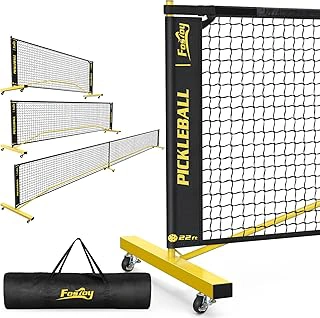
Fostoy Portable 3-in-1 Pickleball Net Set with Wheels
Moving a pickleball net from garage to driveway becomes straightforward with the Fostoy Portable 3-in-1 Pickleball Net Set, which includes an integrated wheel system designed to eliminate lifting. The wheels attach to the frame base, letting you roll the assembled net across pavement, concrete, or smooth asphalt without bending or carrying the unit. This design addresses a specific challenge for players managing shoulder limitations, grip concerns, or simply frequent repositioning between storage and play areas. At $79.99 with a 4.5 rating, the set offers a practical transport solution at a price point below many standard portable nets that require full disassembly or two-person carries.
The 3-in-1 designation refers to adjustable height settings that accommodate pickleball, badminton, and tennis junior play, though most driveway pickleball users will set it to the regulation larger center height and leave it there. Setup involves unfolding the frame, locking the support arms, and rolling into position - the wheels remain functional during placement, so fine-tuning net location requires minimal effort. The tradeoff appears in stability: wheeled bases typically add slight height to the frame contact points, which can affect rigidity on uneven surfaces compared to flat-footed designs. This net works best on level driveways or garage floors where the wheels roll smoothly and the frame sits flush. If your play area includes slope, cracks, or gravel transitions, a fixed-base net may provide better anchoring. For users prioritizing ease of movement over maximum wind resistance, the Fostoy delivers a clear advantage in daily handling with a setup process that respects physical limitations.
- ✅ Integrated wheel system eliminates lifting during transport
- ✅ Adjustable height settings for multiple net sports
- ✅ $79.99 price point competitive with standard portable nets
- ⚠️ Wheeled base may reduce stability on uneven or sloped surfaces
- ⚠️ Best suited for level driveways and smooth pavement
How to Choose the Right Net for Your Driveway and Practice Routine
Choosing a portable net starts with your driveway's actual dimensions and how you plan to practice. Measure the available width first - regulation nets need at least 22 feet of uninterrupted space, while rebounder-style options fit into driveways as narrow as 10 feet. Mark the footprint with chalk or tape to see how much room remains for movement and whether parked cars or landscaping will interfere during setup.
Weight matters more than most buyers expect. A 25-pound net feels manageable in the garage but becomes a different commitment after the third trip from storage to driveway in a week. Compare the listed weight against what you can comfortably carry in one load, and remember that models with wheels shift the effort from lifting to rolling. If your driveway has a slope or gravel surface, wheels may catch or slide, making a lighter frame without wheels the more practical choice.
Setup time directly affects how often you'll actually use the net. Count the steps: unpacking, unfolding the frame, securing the net fabric, and anchoring the bases. Some designs snap together in under two minutes with no tools, while others require threading poles and tightening multiple connection points. Run through one full assembly cycle before your first practice session to identify any awkward steps or missing hardware.
Base anchor systems must match your driveway surface. Rubber pads work on smooth concrete and asphalt, but gravel or textured surfaces may need sandbag or water-filled bases for stability. Windy conditions expose lightweight frames quickly - if your driveway sits in an open area, prioritize models with wider base footprints or additional anchor points rather than assuming minimal weight will suffice.
Storage space often becomes the hidden constraint. Measure your garage or shed to confirm the packed net will fit without blocking other equipment. Nets that fold into a single carry bag take up less vertical space than models that break into multiple loose poles. If you need to move the net between driveway and storage daily, wheels or a compact pack size reduce friction and make consistent practice more sustainable.
Match the net type to your primary practice goal. Solo drills focused on serve repetition and footwork benefit from regulation-width nets that mimic court spacing. Partner rallies and dinking practice require the same full-width setup. Rebounder nets serve a different purpose - they return the ball for solo volley drills but don't replicate match conditions. Decide whether you're training specific shots or simulating game scenarios, then choose the frame and width that supports that work without compromise.
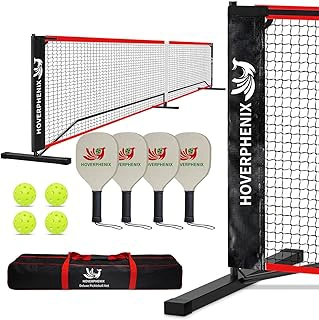
Hoverphenix Portable 22FT Regulation Size Pickleball Net Set
Players who practice multiple times per week need a frame that holds its shape under repeated setup and sun exposure. The Hoverphenix Portable 22FT Regulation Size Pickleball Net Set carries a 4.5 rating and sits at $79.99, occupying the middle ground between budget simplicity and premium features. Its design focuses on frame tension consistency and outdoor material durability, making it suitable for driveways, parks, and other exposed locations where nets face wind and UV over months of use.
Frame tension adjustment is the central advantage here. Unlike nets that rely solely on fixed corner loops, this set allows users to fine-tune sag and height after the initial setup, which matters when the net sits outside for extended sessions or when temperature shifts loosen synthetic fibers. The regulation 22-foot span meets tournament width standards, so footwork and positioning translate directly to court play rather than requiring mental adjustment between practice and competition.
Outdoor durability separates this net from lighter alternatives. Materials chosen for this set prioritize resistance to fading and brittleness under direct sun, and the frame construction accommodates moderate wind without collapsing or requiring constant re-anchoring. Players in climates with high UV exposure or unpredictable gusts will find fewer maintenance interruptions compared to nets built primarily for occasional indoor or calm-weather use.
The $79.99 price reflects the inclusion of tension hardware and weather-resistant components. Compared to the BAGAIL at multiple, the Hoverphenix offers regulation dimensions and adjustable tension at a lower cost, though it may lack some of the premium portability features or accessory organization found in higher-tier sets. For players prioritizing structural reliability over maximum convenience, this trade-off often makes sense.
This net works best for those planning daily or near-daily practice sessions and anyone in variable weather climates who cannot can help calm, shaded conditions. If your driveway practice happens sporadically or in controlled environments, a lighter, simpler net may suffice. But when the goal is consistent performance across weeks of outdoor exposure, the Hoverphenix frame tension and material construction provide the stability that keeps practice productive.
View frame specs and outdoor durability notes
- ✅ Adjustable frame tension reduces sag over time
- ✅ Regulation 22-foot width matches tournament standards
- ✅ Materials designed for UV and wind resistance
- ✅ Mid-range price with durable construction
- ⚠️ Heavier than ultra-portable budget options
- ⚠️ Fewer premium portability features than higher-priced sets
Making Driveway Practice a Sustainable Habit
Choosing the right portable net can be the difference between a dusty garage ornament and a driveway ritual you actually maintain. The four nets in this guide address different friction points that either invite or discourage regular practice.
If your goal is regulation play at home, the BAGAIL and Hoverphenix nets deliver official tournament dimensions and net tension suited for doubles drills and match-style rallies. Both require about five minutes of setup and weigh enough to justify storing them near your practice area rather than hauling them daily.
When transport is the real barrier, the Fostoy net collapses into a lighter, more compact package that fits in a car trunk or closet shelf without rearranging your life. Its shorter frame suits solo dinking drills and hand-eye coordination work, though you'll sacrifice the full regulation height for games.
For players focused on reaction speed and consistency rather than live rallies, a rebounder net turns repetitive ball feeding into a solo workout. It removes the need for a partner and the setup complexity of traditional frames, though it won't simulate match conditions.
The net that supports sustainable practice is the one matched to your current strength, available storage, and how much setup friction you'll tolerate before skipping a session. Features matter less than removing the small barriers that make it easy to postpone another day.
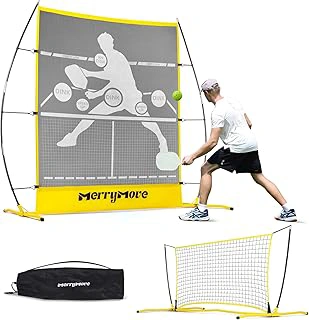
Pickleball Practice Rebounder Net, 6FT Mini Portable 2-in-1 Trainer
Solo practice requires a different tool than full-court play. The Pickleball Practice Rebounder Net offers a 6-foot compact alternative built for volley drills, dink work, and reaction training without a partner. At $74.99, it sits well below regulation net prices and targets players working on specific skills in a driveway, garage, or small yard rather than simulating games.
The 2-in-1 design provides two practice angles: a vertical net position for standard return drills and an angled rebounder mode that sends balls back at different trajectories. This setup helps you work on quick hands at the kitchen line or practice controlling pace on volleys. The smaller footprint means faster setup and easier storage than a longer regulation net, though it also means no partner rallies or serve practice across a full court.
Weight and portability favor this rebounder if space is tight. You can move it solo, set it up in minutes, and store it in a corner or trunk. The 4.2 rating reflects its niche: buyers looking for a full net substitute tend to rate it lower, while those using it strictly for drill work find the size and return angle useful.
Tradeoffs center on purpose. You lose the ability to practice serves, play matches, or work on court positioning. The 6-foot width covers less area than even compact regulation nets, so lateral movement drills stay limited. Stability in wind is less of an issue due to the lighter frame, but that same frame may shift during harder hits unless anchored or weighted.
This rebounder fits players who need skill repetition in constrained spaces or want to supplement court time with solo drills at home. If your practice goals include partner play, serving accuracy, or full-game scenarios, a regulation or compact net remains the better choice. For focused ball control and reaction speed work, the rebounder delivers a portable, budget-friendly option that does one job well.
- ✅ Compact 6-foot size fits driveways, garages, and small practice areas
- ✅ 2-in-1 design offers net and angled rebounder modes for varied drills
- ✅ $74.99 price point lower than regulation portable nets
- ✅ Lightweight frame for quick solo setup and easy storage
- ⚠️ No partner play or match simulation possible
- ⚠️ 6-foot width limits lateral movement and court positioning drills
- ⚠️ Not suitable for serve practice or full-game scenarios
- ⚠️ Lighter frame may shift on harder hits without added anchoring